Friday, July 1, 2016

Bakery balancing act

What is in this article?:

Food retailers need to consider a wide range of factors when determining whether to centralize their baking operations, and they also need to consider what degree of centralization to pursue.
Equipment costs, employee skill levels, square footage available and transportation issues all need to be taken into account.
Centralized baking works for bread baking because it creates greater product consistency.
Many retailers say that having an in-store bakery adds to the ambiance of the supermarket and lends itself to a higher degree of customer service, but others say the product consistency and the cost efficiencies of centralization favor that approach instead.
“There are benefits to both,” said Peter Barbaro, program bakery director at Riesbeck’s Food Markets, St. Clairesville, Ohio. “We like doing scratch baking in the stores — it allows us to interact more closely with our clientele. Plus, we have a lot of people in our stores who are very experienced — some who have been here 30 or 40 years.”
Having a high degree of skills and experience at the store  level is an important element of in-store baking, he noted. Retailers with less experienced staff, or those who lack the square footage to install the equipment needed for a comprehensive in-store scratch bakery, might be better served by having some degree of centralized baking.
Some retailers employ centralized baking for seasonal or specialty items, and others for items such as cake blanks that can be assembled and decorated at individual store locations. Centralization can also be a profitable solution for retailers making a big push into gluten-free or nut-free baking, he noted, because it enables the establishment of a dedicated facility for these types of items.
Coborn’s, for example, opened a dedicated gluten-free bakery last year, and Whole Foods also has a gluten-free bakehouse, according to its website. Products from Whole Foods’ gluten-free facility — which include sandwich breads, pizza crust, cookies and desserts — are shipped frozen to individual Whole Foods stores.

Labor and equipment

Bread-baking in particular requires a high degree of investment in labor and equipment, Barbaro noted, and therefore lends itself to a more centralized approach.
Riesbeck’s has considered the possibility of centralizing its bakery operations in the past, but for now conducts much of its baking at the individual store level, including doughnuts and custom cakes. For fresh-baked breads, the company has full bread-baking operations in about half a dozen locations, which each supply two or three other nearby stores with fresh-baked bread and rolls every day.
This type of operation, in which designated stores supply certain bakery products to other locations, “is similar in process to centralized baking,” Barbaro said, but “broken into smaller  volumes.”
“If you do this repetitively, and using your seasoned bakers at one location, there is greater [return on investment] because of consistency,” he said.
While bread-baking might be better suited to centralized baking, custom cakes are often best left to the individual stores, Barbaro noted.
“When you are doing custom cakes, you need that one-on-one interaction with the customer,” he said. “It’s like a hairdresser — the customer is used to getting it from that one location, and if they go someplace else, they can tell the difference.”
Transportation is also an issue retailers have to consider in a centralized bakery operation, Barbaro explained. Costs can add up quickly if deliveries have to be made over a long distance from the central bakehouse to the store.
In fact, Peter Sommers, bakery director at Martin’s Super Markets, South Bend, Ind., said distribution issues — such as maintaining delivery trucks, cabinets and shipping containers — were one of the challenges when it comes to operating a central bakery operation.


Martin’s divides up its fresh bakery items between its Central Bakery in Mishawaka, Ind., and its in-store baking operations.
“We have taken a ‘who can do it best’ approach,” said Sommers. “Our Central  Bakery makes items across many categories — breads, cookies, doughnuts, sweets, and all-occasion and custom cakes.”
Martin’s continues to bake many of its items in-store, “especially short-shelf-life items,” he explained.
“We also bring high-quality thaw-and-sell items where it makes sense,” Sommers said. “Our goal is to be unique as possible in our marketplace.”

Efficiency and consistency

In addition to using the Central Bakery to create unique items, the advantages of centralized baking include efficiency and product consistency, he said.
Although Martin’s does hire bakers with outside experience, the retailer trains most of its bakers in-house, and rotates them through the Central Bakery to learn new skills.
In addition to its gluten-free facility, Whole Foods also operates five bakehouses around the country (as of late last year), according to a recent local TV report.
Whole Foods declined to comment on its baking  operations.
According to the report, the newest facility, which relocated from Plantation, Fla., to Pompano Beach last year, measures 29,000 square feet and employs about 60-70 bakers per day. It supplies 24 Whole Foods locations in the region, churning out 29,000 pounds of bread per day.
Some of the product ships ready to eat, while other items are par-baked and flash-frozen, according to the report.

The Truth Behind Trader Joe's Low Prices


There are many die-hard fans of Trader Joe's who will assure you that it's the best grocery store ever. And that's not just hearsay.
The great value for quality goods is what keeps customers coming back for more. But all of us have wondered from time to time how in the world Trader Joe's manages to pull that off. Although I don't ever want to ruin a good thing, my curiosity got the better of me and I decided to do some digging. Here are a couple of possible reasons:

1. Smaller spaces

"Most TJ's locations have less square footage than the average mainstream grocery store, so I'm sure they save on their overhead costs that way," says Nathan Rodgers of review site What's Good at Trader Joe's. "And it appears they pass some of those savings on to their shoppers."

2. Smaller headcount

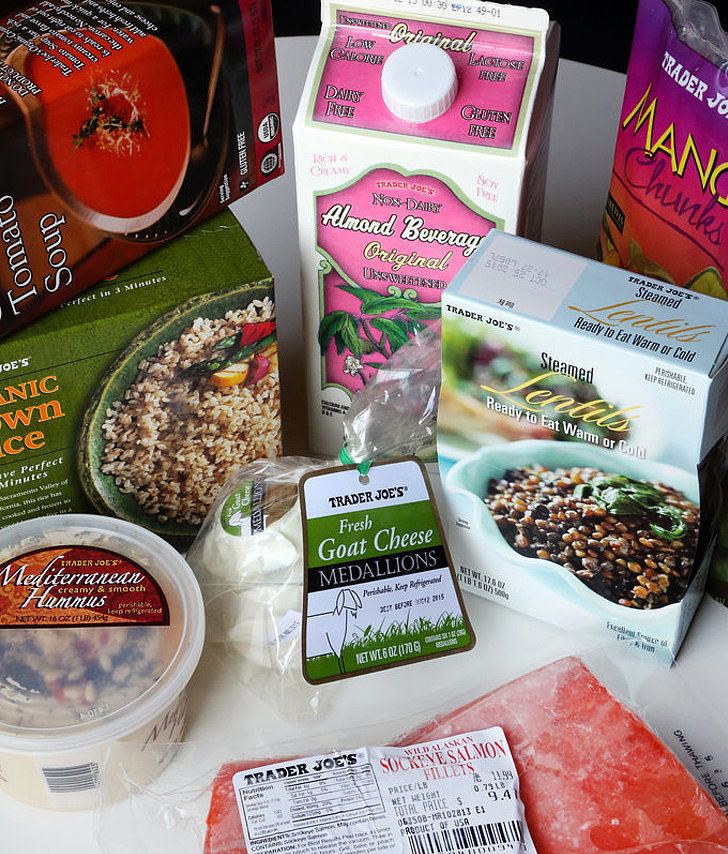
To keep costs down, the chain generally has a lower headcount in its stores than its competitors, although there are exceptions. You won't find some of the traditional supermarket positions, like a butcher and a baker, at Trader Joe's, which also helps with costs. This means that customers can only buy precut meats and premade baked goods, but that doesn't seem to deter consumers.

3. Less selection

Trader Joe's has a smaller selection of goods, and most of its products are offered under the store-brand label, which differentiates it from other grocery chains. Fortune estimates that the typical grocery store has 50,000 items, while Trader Joe's has 4,000 — 80 percent of which are store-brand goods. Its small store sizes also don't allow for a bigger selection of goods.
This can be a negative or positive, depending on how you see the situation, because there are definitely people who do enjoy the smaller selection. Rodgers says, "Honestly, I have a hard enough time making decisions as it is. A smaller selection actually helps narrow down the choices. Plus, they're constantly shuffling things around and introducing new products. The thing that bothers me most is that they discontinue really great products occasionally."
By limiting its selection, Trader Joe's will buy larger quantities from suppliers. And it will restock at a faster rate because of the quicker turnaround — it is able to sell more of one type of product when there aren't too many choices. These two factors will drive down the costs. Although there isn't a lot of variety, customers are OK with that because they trust that the quality will be good, according toFortune.

4. Not everything is certified organic

Some products have the label "made with organic ingredients," which Mark Kastel, cofounder of organic food industry watchdog group The Cornucopia Institute, says may mean only 70 percent of the ingredients in the product are organic. For example, the label may say the pizza was made with organic wheat and vegetables, but the cheese and meat might not be organic, which means you're getting a really "cheapened product."
"When you are going to Whole Foods or Trader Joe's or any store you have to be a conscious consumer because a lot of what is most profitable to them is not organic even though they really like to tout that they are organic," says Kastel. His advice is to take a careful look at the labels to make sure the whole product is certified organic.

5. Private about the suppliers

Trader Joe's is notoriously private about its suppliers. This is also a trademark trait of its parent company, German supermarket conglomerate Aldi. "Their hallmark is what we call private label or store brand. So you don't really know who is manufacturing it and where it's from or maybe the story behind the food," says Kastel. This enables Trader Joe's to use a competitive bidding system with suppliers and go with the lowest bid. Customers won't know when the manufacturer of the product changes.
The anonymity also benefits the suppliers as they don't want customers to know that they are making a lower-cost version for the Trader Joe's label. Last year, The Huffington Post did a taste testcomparing Trader Joe's products they speculated were produced by big brands to the actual products sold under the big-brand names. The testers found that although there was a big price difference, there were no obvious differences in taste.
However, the secrecy can brew dissatisfaction among some consumers. Vani Hari, investigative food journalist and founder of FoodBabe.com, says, "If you shop at Trader Joe's and buy their Trader Joe's branded products, you'll never know which companies are producing your food. You could be supporting a company with shady or unethical business practices. Other major supermarket chains like Target and Kroger are also creating their own private label products that also create similar concerns with consumers. With the increased emphasis on the 'voting with your dollars' mentality and ingredient labels, consumers want to know where their food comes from."

6. Efficient distribution and supplier system

The company also cuts out the middleman and buys a lot of its food directly from the suppliers, which translates to lower expenses and more savings for customers. Suppliers send their food to Trader Joe's distribution centers, where it then gets sent out to the stores. Traditional supermarkets usually buy their food through a distributor, which adds on more cost.

7. Food is sourced all over the globe

Food Babe's Hari says, "Trader Joe's is able to keep their produce and goods inexpensive because they source their goods from all over the globe — especially from underdeveloped countries where prices are cheaper." The danger in this strategy is the organic food industry in foreign countries may not be well regulated.
Back in 2008, to deal with the growing concern over organic food from China, Trader Joe's announced that it planned to phase out any single-ingredient food item from China. This is a big deal given that not a lot of supermarkets follow suit. Whole Foods did not do the same and said it was in a "different position" and it didn't make sense to stop the progress it has "made with sourcing select high-quality products." However, although Trader Joe's phased out the single-ingredient items, it's not clear which multiple-ingredient products use organic ingredients from China and which other countries it is sourcing its single-ingredient products from.

8. Less money spent on marketing

The company is known for not spending as much money on marketing and advertising as its competitors. In fact, it doesn't even have an official Facebook or Twitter page. Chances are, you probably heard about the grocery chain through word of mouth. The chain has such a devoted following that customers become the brand's best "advertisers," promoting the stores in various ways — from uploading images of their favorite Trader Joe's snacks on Facebook to convincing friends to shop there. The bonus in this strategy is that the advertising costs won't be tacked on to Trader Joe's goods.

So what does this mean for those who want organic food?

It means we have to be careful as consumers and read labels. We can also do our homework and learn how to shop smart. You can start with organizations like The Cornucopia Institute, which has several helpful reports such as one that ranks the quality of dairy of several suppliers and grocers. Kastel recommends people shop at their local food co-op, which he says is the "gold standard of organic retailing."

New study compares transportation energy efficiency of local and conventional food

Farmers located closer to city may be more prone to withstand energy price shocks
UNIVERSITY OF TENNESSEE INSTITUTE OF AGRICULTURE
KNOXVILLE, Tenn. - Two researchers at the University of Tennessee Institute of Agriculture find that farmers located closer to city centers seem to have a locational advantage in transportation over their long distance, conventional food supply chain competitors.
In an article published June 20 in the spring 2016 issue of the Journal of Agriculture, Food Systems, and Community Development, Chuck Grigsby, marketing specialist with the UT Center for Profitable Agriculture, and Chad Hellwinckel, research assistant professor of agricultural and resource economics, compared the transportation efficiencies of the conventional and local fruit and vegetable transportation networks in the Knoxville-area surrounding the University's flagship campus.
After systematically studying the transportation efficiency of local farmers in the Knoxville region, the researchers highlight two main factors that impacted local farmers' competitive advantage in transportation:
(1) Farms located within 25 miles of the downtown market tend to deliver their produce to market at least as efficiently as conventionally distributed foods from California; and
(2) More distant farms need to scale up their production and distribution operations to remain within the competitive transportation zones.
The authors reached a third conclusion: defining travel distance thresholds of cities could provide policy-makers with useful information in planning land use and infrastructure investment projects for local food systems and for designating sustainable geographic boundaries for local food economies.
"We started by asking a simple question," says co-author Chuck Grigsby. "Can local farmers transport their products to market as efficiently as foods transported from distant locations, such as California, Florida or Texas? We found that in some cases the answer to this question is, "yes" but local farmers' competitiveness largely depended on their travel distance to market and their production and distribution scales."
Co-author, Chad Hellwinckel, further elaborates on the potential impact of the research: "Food systems where most of the local farmers are located near consumer markets may be more sustainable and resilient to sudden fuel price shocks. In our study, the farming operations closest to market usually had improved transportation fuel use efficiencies compared to foods shipped from California, despite the local farmers' relatively small truckload weights."
The authors believe that their conclusions could be useful to stakeholders working to build more resilient local food economies.

Why Some of Instagram's Most Popular Food Accounts Are Fleeing to Snapchat

 #Foodporn is coming to your snaps 
Foodies are testing Snapchat's real-time posts. Sources: Julieskitchen, EatingNYC, Snapchat
Instagram's long-awaited algorithm has finally started rolling out, and food influencers and sites that built their brands on the Facebook-owned app are already feeling the squeeze and moving to Snapchat.
Food photography—think pictures of perfectly-styled plates and overhead shots of meals—has long been one of the most popular categories on Instagram. Now that Instagram is stepping up its advertising and video efforts (the platform claims that it has more than 200,000 monthly advertisers) creators that have amassed large and active followers are having a tougher time standing out.
"As Instagram has really slowed down the last four months or so, you can just see what's happened on that platform and it's obviously changing a lot," said Andrew Steinthal, co-founder of The Infatuation, a restaurant review site that's heavily leaned on Instagram to build a following since launching in 2009.
"Our entire audience is on Snapchat now—it's the most reactive social network that we have. You can just see the impact on Snapchat and feel it right away right now. People are so deep into Snapchat and reacting to it."
Steinthal said that The Infatuation has been on Snapchat for about a year, but has only recently started ramping up its social content for the app. Unlike its work on Instagram that has relied heavily on user-generated photos, Snapchat is proving to be a more laborious platform.
"It's so much work to populate a Snapchat account with good content," Steinthal said. "Whereas on Instagram, you can populate with really good user-generated content, Snapchat is all original. To be good at Snapchat is hard and takes a lot of planning, execution and coordination."
For example, The Infatuation built a following on Instagram several years ago by encouraging foodies to tag their posts with the popular hashtag #EEEEEATS. More than 3.3 million Instagram posts have now been tagged with the #EEEEEATS hashtag, and The Infatuation is now working on creating similar viral tactics on Snapchat.
Revenue is moving to Snapchat for The Infatuation, too. The site has created sponsored Snapchat stories for brands including Budweiser and American Express, and it will launch a campaign for Nestlé's chocolate brand Damak at an event in New York this week.
As part of its Pride Day campaign last week, The Infatuation partnered with American Express for an event at New York restaurant The Spotted Pig, creating location-based Snapchat filters that attendees could add to their photos.
"For the most part, if you're buying a package from us, there's going to be a Snapchat story included," Steinthal said.
New York-based account Devour Power also usually throws sponsored Snaps into ad packages. "Say a restaurant wants to gain exposure and contacts us—we then reply with different packages we offer and we'll go in and snap the experience so our followers can have an idea [about] what the place and food is like on top of seeing the photo on Instagram," said Rebecca West, who runs the account with Greg Remmy.
Alexa Mehraban, who runs the popular EatingNYC Instagram account, regularly tags her Instagram posts with her Snapchat account and encourages her 199,000 fans to follow her on there. "The platform provides so much more depth than Instagram," she said, particularly for off-the-cuff and behind-the-scenes content that shows her fans her personality rather than just photos and videos of food.
Branded content is a slippery slope on Snapchat though. Mehraban said the app is "still a pretty grey area" in terms of abiding to the Federal Trade Commission's guidelines that require influencers to disclose and label content as sponsored when they are paid by a brand.
Mehraban said when she works with brands to create Instagram content, there's typically a contract and legal forms included, but she hasn't worked with advertisers on Snapchat yet.
That's not to say that brands aren't able to plug their products through influencers' Snapchat accounts though. In lieu of running a full-blown campaign on Instagram, Mehraban sometimes offers brands a bit of product placement in her snaps.
"A lot of times people want to send things for delivery and to be featured on Instagram—that's something that I don't always want to do because for me it takes a lot of time," Mehraban said. "I'll say to them, 'I'll be happy to feature it on Snapchat if you want some kind of promotion.' Brands are usually fine with that. It's a lot of trial and error and seeing what works."
Jackie Gebel, who counts 189,000 followers through the No Leftovers Food & TravelInstagram account, has also worked brands' products into her Snapchat stories without doing a formal campaign.
"If a brand wants to send products for a post, I can't say yes to everybody because it's too much branded content and I don't do much sponsored content anyway," she said. "I cook a lot on Snapchat way more than I do cooking stuff on Instagram, so I'll show the ingredients that I'm using."
Gebel added that she doesn't know how many followers she has on Snapchat, but said that she's averaging a little over 5,000 views per story.
"I spend more of my time contributing content to Snapchat than Instagram," Gebel said. "I have way more followers on Instagram, but I think it's so much more personal. People who watch my Snapchat stories aren't just followers—they're really engaging with me and care about what I'm doing in my day-to-day life."

Century-old Woodman's expanding suburban reach

  • Woodman's opened its Carpentersville location in 2004, and is now making a bigger push into the suburbs with proposed stores in Buffalo Grove and Lakemoor.
     Woodman's opened its Carpentersville location in 2004, and is now making a bigger push into the suburbs with proposed stores in Buffalo Grove and Lakemoor.
    Rick West | Staff Photographer

  • Produce sits on pallets at Woodman's grocery store in Carpentersville. It's a no-frills environment that keeps prices low, experts say.
     Produce sits on pallets at Woodman's grocery store in Carpentersville. It's a no-frills environment that keeps prices low, experts say.
    Rick West | Staff Photographer
Since its humble beginnings nearly a century ago in Janesville, Wisconsin, Woodman's Food Market has been a family business.
But with the roughly 100,000 items that now fill each of its stores' shelves -- dozens of varieties of ketchup, peanut butter and potato chips alone -- you might call it a mega mom-and-pop operation.
Woodman's Kenosha location is believed to be the largest grocery store in the nation at 252,345 square feet, and the company has proposed opening two more stores in the suburbs that are nearly as big.
Stores announced this year for Buffalo Grove and Lakemoor represent the Wisconsin company's continued expansion south of the border into the Chicago-area grocery market, where they hope to compete for the increasingly coveted suburban food shopper's dollar.
"It's an operation that is designed to move a lot of product and to do it at extremely aggressive price points," said Jim Hertel, senior vice president of Willard Bishop, a Long Grove-based grocery retail consultant. "You give up some things as a shopper there -- it's not a high-frills environment -- but if what you're looking for is an opportunity to save fairly significantly on your grocery bill, it's definitely an operation you should try."
Woodman's offers long aisles of frozen and refrigerated foods, in addition to nearly two dozen aisles of dry and packaged goods.
  Woodman's offers long aisles of frozen and refrigerated foods, in addition to nearly two dozen aisles of dry and packaged goods. - Rick West | Staff Photographer
Shoppers who load up their carts at the grocer's existing suburban locations in Carpentersville and North Aurora already are familiar with the Woodman's experience: Aisles and aisles of packaged goods, refrigerated and frozen foods, and produce -- available 24 hours a day, seven days a week.
An attached liquor store is open most of the day, and on the way home, drivers can fuel up at the store's gas station, which also offers carwashes and oil changes.
Woodman's estimated weekly sales of about $1.5 million are on par with a successful Whole Foods, but nearly four times that of conventional grocers, according to Hertel.
Multiple registers stand at the ready at Woodman's in Carpentersville. Moving lots of inventory on a large scale has proved to be a winning strategy for the company, according to one consultant.
  Multiple registers stand at the ready at Woodman's in Carpentersville. Moving lots of inventory on a large scale has proved to be a winning strategy for the company, according to one consultant. - Rick West | Staff Photographer
With more than $1 billion in annual sales at 16 stores in Wisconsin and Illinois, what makes the company so successful?
For one, Woodman's saves money by refusing to accept credit cards -- thus avoiding costly processing fees. And labor costs are lower because the company's 3,000-plus employees aren't unionized. The company has been 100 percent employee-owned since 1998, with 30 percent of the company owned by Woodman family members.
Hertel says the sheer size of Woodman's stores and the amount of inventory going in and out also helps drive its profitability.
"Would you rather have a fast nickel or a slow dime? Fast nickels generally win," Hertel said. "So many different competitors have to work hard to stand out these days, but Woodman's does it. They've carved themselves a very successful niche."
A trip to Woodman's means a lot of brand-name choices for shoppers. This is the bread and bakery area of the Carpentersville store.
  A trip to Woodman's means a lot of brand-name choices for shoppers. This is the bread and bakery area of the Carpentersville store. - Rick West | Staff Photographer
Woodman's didn't start building its superstores until the late 1970s when it completed a 90,000-square-foot store in Madison, Wisconsin. Then came even bigger stores of 125,000 square feet in the 1980s.
The prototype store now is 240,000 square feet, which is the proposed size for the locations in Buffalo Grove and Lakemoor. Of that, 140,000 square feet is for the grocery store itself, while the remainder is a warehouse to store dry goods, as well as other items in freezers and coolers.
Bret Backus, Woodman's vice president of real estate, told Buffalo Grove trustees last week the company is committed to staying for the long run.
"In terms of a corporate citizen, what you're getting from us is an investment in the community," as opposed to a store where, "at the end of 15 or 20 years we could move to a different community," Backus said. "We have closed one grocery store in our almost 100-year history, and that was to move to a larger facility."
The Buffalo Grove location, on the northwest corner of Milwaukee Avenue and Deerfield Parkway, is targeted for completion during the late summer or early fall of 2018.
The Lakemoor location, on the southwest corner of Routes 120 and 12, isn't a done deal. A lawsuit filed by three taxing bodies against the village regarding the legality of a special financing district remains unsettled. And officials say there are flooding issues that make the site difficult and expensive to develop. Nonetheless, Woodman's officials say they're still interested in the location.
Buffalo Grove's village board approved a sales tax sharing agreement last week with Woodman's -- a deal that promises to rebate up to $7 million over 20 years. Woodman's is paying $4 million for off-site roadway and intersection improvements, including street widening, more turning lanes and a center median.
Sales tax incentives were also approved when Woodman's came to North Aurora in 2007 ($5.2 million over 15 years) and Carpentersville ($1 million) in 2004.
A shopper wheels down the wide aisles of the soft drink section of Woodman's grocery store in Carpentersville.
  A shopper wheels down the wide aisles of the soft drink section of Woodman's grocery store in Carpentersville. - Rick West | Staff Photographer
"It's something that we are earning," Backus said at last week's Buffalo Grove village board meeting. "We don't look at it as something that's being gifted to us. It's not corporate charity. It's something where we're coming in and making an investment in Buffalo Grove."
Municipalities have been content to ink the deals because of the promised sales tax revenue for their coffers -- even after rebating some of it back -- as well as the additional economic development that results when a Woodman's comes to town.
In North Aurora, Woodman's has generated an average of $900,000 worth of sales taxes in each of the last three years. Of that amount, Woodman's gets back half, per terms of its agreement with the village.
"It is a draw well outside North Aurora," said Village Administrator Steve Bosco. "The only way you can explain the amount of sales they do is consider this is a town of just under 17,000 residents."
Buffalo Grove officials estimate the Woodman's project and other expected nearby development could generate as much as $25 million in new revenue for the village in more than 20 years.