Sunday, October 9, 2016

Revisited: Whole Foods, Wal-Mart And The Coming Commoditization Of Organic Grocers

|
1 comment 
|
 About: Whole Foods Market, Inc. (WFM)Includes: WMT

Summary

Two years ago I wrote an article examining the organic grocery industry, and questioning the viability of the growth expectations priced into Whole Foods' stock.
Since then, Whole Foods has seen its growth slow significantly, largely driven by the massive increase in competition.
While Whole Foods is still a solid company, its stock is unlikely to see a return to the premium growth valuation multiples it once enjoyed.
In July of 2014, I wrote an article here on Seeking Alpha titled, Whole Foods, Wal-Mart and The Coming Commoditization of Organic Grocers, in which I hypothesized that a coming shift in the organic grocery industry would spell trouble for Whole Foods Market's (NASDAQ:WFM) stock price. At the time, their stock had recently tumbled from the $60s down into the high $30s, leading many bulls to excitedly declare a buying opportunity. I presented a counter-argument to this case, cautioning that the premium valuation multiples that WFM had historically traded at had become outdated and that the stock had additional room to fall.
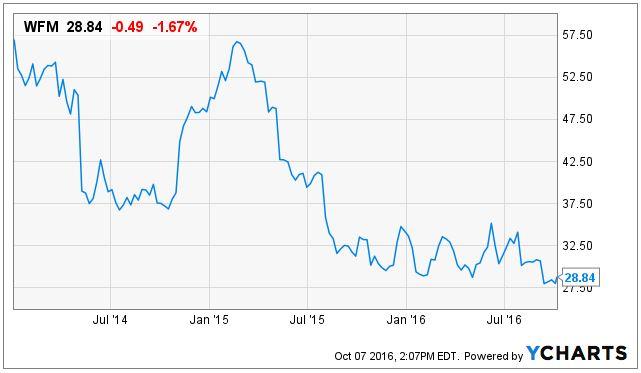
WFM Stock Price
Most, if not all, of my article was admittedly speculative and very much qualitative in nature. After all, I was making an educated guess at what the long-term future of a major industry would look like. Two years later, I believe that enough time has passed to check in and see how things are playing out.
While I encourage you to go read (or re-read) my initial article, my argument can be summarized as follows:
  1. The entry of Wal-Mart (NYSE:WMT) into the organic grocery industry in 2014, while not posing a direct threat to Whole Foods, signaled a significant shift in the broader industry. What was once a small niche market was quickly becoming a mainstream norm.
  2. Whole Foods would remain successful from a business standpoint.However, the growth expectations historically factored into their stock price would prove inaccurate. Industry-wide growth would be driven by demographics that are much more price-sensitive than the traditional Whole Foods shopper.
  3. While investors were accustomed to WFM trading in the 30-40x P/E range, buying below that range didn't necessarily make it a bargain.
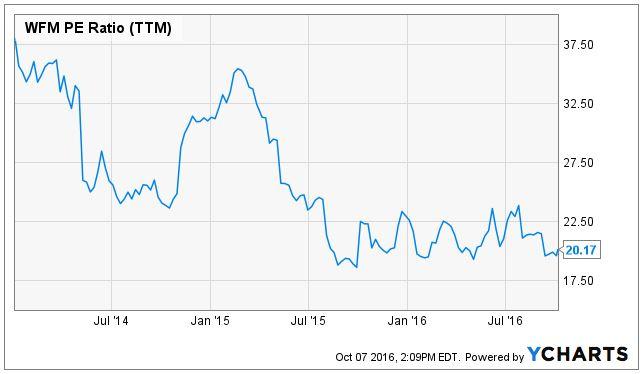
WFM PE Ratio (NYSE:<a href='http://seekingalpha.com/symbol/TTM' title='Tata Motors Limited'>TTM</a>)
In short, I believe that my thesis is playing out as predicted and will continue to do so for the foreseeable future. Whole Foods' management seems to agree, taking time during recent conference calls to acknowledge the increased competition and introduce a set of new initiatives in response. While management is certainly taking action to address the situation, it remains to be seen if this will be enough to boost the stock price back to the premium valuation levels it once enjoyed.
The historical "bull case" for WFM has always seemed to rest on two major pillars: First, Whole Foods will eventually expand to management's stated goal of 1,200 stores (more than double their current store count). Second, Whole Foods will maintain their premium pricing power within the industry. I've long conceded that if both these points hold true over the long run, WFM is a must-buy at current prices. However, I have long questioned the long-term viability of these two pillars, and believe they are currently beginning to crumble.
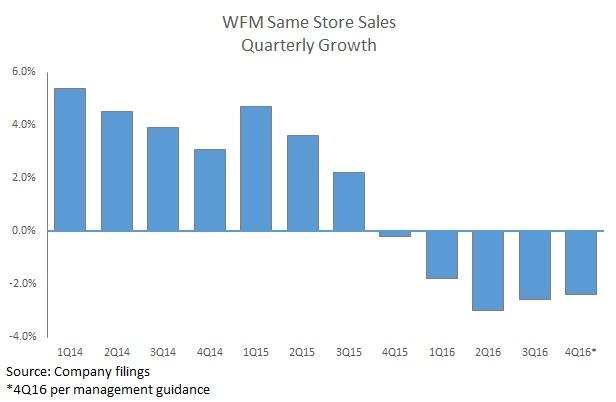
WFM Same Store Sales - Quarterly Growth
Looking at Whole Foods' business performance over the past two years, it's easy to see why the stock price has struggled. Same-store sales, once averaging 8% annually over a 15-year period, have fallen off a cliff. After steadily declining through 2014 and 2015, the metric went negative in Q4 of 2015 and is expected, per management guidance, to remain negative through at least the end of 2016. In their most recent quarterly earnings call, CEO John Mackey acknowledged that competition was taking its toll:
"[C]ompetition, I mean it's not a big secret, is it? There's a lot more competitors in the marketplace and there's a lot of new formats in the marketplace, from home meal replacement to meal kits, fast casual restaurant growth. More entrants in the natural and organic food space. The mainstreaming of natural organic, which has been well reported. These are all factors.
[…] We probably feel the brunt of it, as there's a bit of a regression to the mean as we lose customers from a convenience standpoint. People don't drive as far as they used to drive, because there's good enough alternatives in many cases close by to them.
So people may not be driving as frequently as far as they used to, because they can stop by a Kroger or an HEB or a Wegmans to get products that they can use to only be able to get Whole Foods… So, I think there's no sense in denying it."
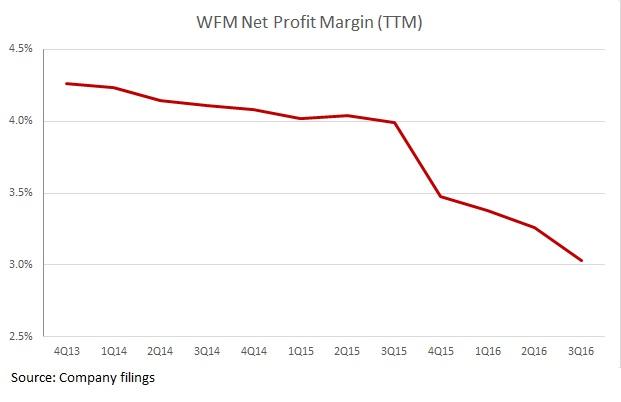
Along with the decline in same-store sales, Whole Foods has also seen their margins shrink significantly over the past two years. On a trailing twelve-month basis, gross margins have eroded from 35.8% to 34.4%, and net profit margins have dropped from 4.3% to 3.0%. To be fair, these margins are still quite impressive when compared with many other grocers, but they are indicative of management efforts to become more competitive on pricing.
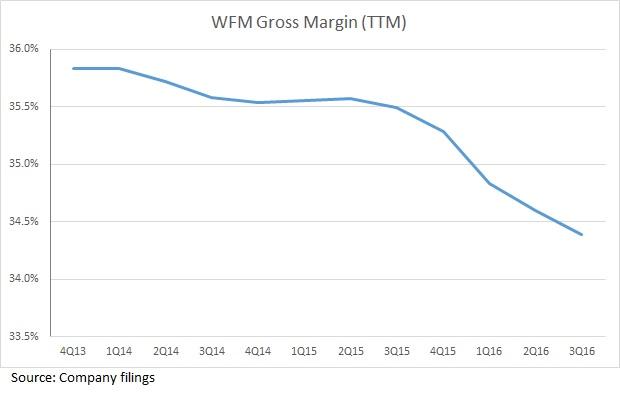
WFM Gross Margins
WFM Net Profit Margins
Back in 2014, a major cause for concern among Whole Foods investors was the entry of Wal-Mart into the organic grocery industry. The overwhelming consensus, which I agreed with, was that Whole Foods and Wal-Mart were completely different companies catering to completely different demographics, and that it was absurd to think that Whole Foods customers would suddenly defect to Wal-Mart for lower prices.
However, in my initial article, I argued that while Wal-Mart's low prices did not pose a direct threat to Whole Foods, it did signal a massive shift in the broader organic grocery industry. While Whole Foods and Wal-Mart represent the two extreme ends of the industry, there are numerous other competitors at various points in-between. These include other mass retailers (Target (NYSE:TGT), Costco (NASDAQ:COST), etc.), traditional supermarkets (Kroger (NYSE:KR), Safeway (NYSE:SWY), Publix (OTC:PUSH), etc.) and "2nd tier" organic grocers (Trader Joe's, Sprouts (NASDAQ:SFM), Fresh Market (NASDAQ:TFM), Fairway (NASDAQ:FWM), etc.). I believe this is an important way to think of the organic grocery industry due to the demographics that are driving industry-wide growth. A recent report from the USDA states that:"organic products have shifted from being a lifestyle choice for a small share of consumers to being consumed at least occasionally by a majority of Americans." While the loyal Whole Foods "lifestyle" shopper may not be overly sensitive to price, the majority of Americans certainly are, and they are the ones who are driving the broader industry growth. While Whole Foods may not need to be concerned with how their prices compare to Wal-Mart, they do need to be concerned with how their prices compare to competitors like Trader Joe's or Sprouts.
In fact, on the WFM 2Q16 earnings call, company President & COO A.C. Gallo admitted that they were actively monitoring competitor pricing and cutting prices when necessary:
"We noticed last - I think starting in November that Trader Joe's had lowered prices in certain items, in certain markets. And we monitor Trader Joe's and other competitors very closely, and we make sure we have certain price bandwidth that we make sure that we follow with them. And so in key items that we saw Trader Joe's change pricing on, we changed pricing as well on certain items to make sure we maintained our proper bandwidth to them."
To give management credit, they've recognized that the competitive landscape has become a lot more challenging, and they are taking steps to make sure the company remains an industry leader. In the Q4 2015 conference call, CEO John Mackey acknowledged that the competitive landscape was shifting, and laid out a 9-step plan for adapting. These steps include reducing operational costs, an increased focus on private-label brands, increasing sales and promotional activity, and launching a new brand of small-footprint "365" stores.
These new initiatives will likely have a positive impact, and Whole Foods will likely continue to operate as a successful company. However, it is unlikely that these initiatives will return the company to their high-flying growth numbers of the past. Investors expecting an imminent return to the $50s or $60s may be better off dumping their shares in the compost pile instead.

Friday, October 7, 2016

Meet the Cyber Sam Walton

New Walmart e-commerce CEO Marc Lore and Walmart CEO Doug McMillon at the investor meeting.
Wal-Mart Stores Inc.
The new head of Wal-Mart Stores' e-commerce business was introduced this week as a kind of Cyber Sam Walton, whose innovative approach to the online shopping trip will pioneer what CEO Doug McMillon termed "EDLP 2.0."
Marc Lore, who was named CEO of e-commerce at Walmart when the retailer acquired his Jet.com business for $3.3 billion less than a month ago, was short on the specifics of how he would transform Walmart's considerable but relatively lagging e-commerce business, but reiterated that the big retailer and its entrepreneurial new e-commerce leader shared a vision for success in retailing by attacking its inherent costs and passing them along to consumers. He also expressed confidence that the combination of Walmart's existing assets and Jet's virtual expertise could accelerate the vision of "seamless" shopping long pursued by his new employer.
"I couldn't be more excited when I look around and see the vast assets that are at our disposal here," Lore said during remarks at Walmart's investor meeting Thursday in Bentonville, Ark. "The foundation has been laid in terms of the warehouse network. I think the decision to build five mega centers was the right one. There's incredible automation there and they're just starting to come up online, and so it's sort of like the perfect time to really accelerate the business. The sourcing capabilities relative to what we experience is not even close."
Lore said Jet.com was founded behind the notion that e-commerce marketplaces, such as Amazon, were "incredibly inefficient," because they are built so as to award sales to the lowest price item provider, regardless of the costs associated with fulfilling the order. Jet.com's breakthrough, he said, was to craft a technology that not only takes fulfillment costs into the equation, but builds baskets by making the process transparent to shoppers, showing them what the savings are of buying one product over another, and by also employing other incentives to save such as options on payment methods, shipping times or returns.
"So for example, if you have two things in your shopping cart, let's say, a bag of dog food and a dog bowl, and now you search for a dog leash, we'll, in less than a second, calculate the marginal cost to ship each one of those leashes in relation to what's in your shopping cart, knowing where you live in relation to all known inventory pools," he explained. "So some leashes, obviously, we'll bill to ship together. And in that case, the marginal cost to ship will be almost nothing, or it may ship completely separately and it might be $5. The idea is to try and encourage consumers to buy things that will ship together from a location in close proximity to where they live."
These basket economic ideals, which McMillon termed "EDLP 2.0" could transform not only Walmart's existing e-commerce business, but its stores and culture, McMillon told analysts. "EDLP still has a place in life that lowers cost and is very powerful," he said, "And on top of that, if you can let customers play a role in this process — a legitimate, authentic, transparent opportunity for customers to participate in a way that helps lower systems cost and you give that money back to them — you can win. We did that before and we want to go do it again."
Specific details on how it will all play out may have to wait.
Lore for example said fresh food would be "a critical part of the strategy going forward," but, like Walmart, it was still experimenting on the best way to conquer the last mile there. Walmart has focused on store grocery pickup, but is also testing its own delivery fleet as well as using Uber and Lyft for delivery in some markets. Jet ships food from a centralized distribution center. "One thing is for sure, we're going to be really focused on winning in fresh and consumables over the next couple of years," Lore said. "And we're just not quite sure what the final best way to do it is, but we're experimenting."
Read More: http://supermarketnews.com/walmart/meet-cyber-sam-walton#ixzz4MRpyVR4h

Analyst: Kroger-Whole Foods rumor doesn't pass smell test

Market speculation of Kroger acquiring rival Whole Foods Markets sent stock in both companies rising on Thursday, but an analyst told SN Friday such a deal seemed farfetched.
"Why would Kroger want it?" Joe Feldman, an analyst with Telsey Advisory Group, said Friday when asked by SN about the speculation. "Kroger is already taking share in the space, as are others. And, it would cost a fair amount."
Whole Foods stock was up by 5% on the speculation, Thursday, that appeared to originate from a since-deleted remark on social media referencing "chatter" of a potential Kroger-Whole Foods deal. Neither company offered comment on the rumor.
Read More: http://supermarketnews.com/retail-financial/analyst-kroger-whole-foods-rumor-doesnt-pass-smell-test#ixzz4MRozOfUp

Tuesday, October 4, 2016

Boston-Based Cosi Files For Chapter 11 Bankruptcy

Cosi of Boston, the fast-casual restaurant company, has filed voluntary Chapter 11 petitions in the U.S. Bankruptcy Court for the District of Massachusetts. Cosi is an international fast food restaurant company, and its menu features made-to-order sandwiches, hand-tossed salads, bowls, breakfast wraps, melts, artisan flatbread pizzas, snacks and desserts.
Company officials said they initiated a process to preserve value and accommodate an orderly going-concern sale of Cosi’s business operations. Cosi’s board of directors unanimously determined that a sale in Chapter 11 is in the best interest of the company and its creditors. The process allows Cosi to continue normal business operations during the Bankruptcy Court-supervised sale process.
Prior to the Chapter 11 filing, the company closed 29 of its 74 company-owned restaurants. The 31 franchised locations are unaffected. The plan outlines a fast-track process that will allow Cosi to emerge from the restructuring under new ownership and with an improved financial position and stronger brand. Cosi has obtained approximately $4 million in post-petition debtor-in-possession financing, which, subject to Bankruptcy Court approval, will provide the company with liquidity to maintain its operations in the ordinary course of business during the Chapter 11 process.
“We worked very hard to avoid this step,” said Mark Demilio, Cosi’s board chairman. “With the advice and support of outside advisors, we’ve explored multiple paths, including raising capital through equity and/or debt in either public or private transactions, selling the company outside the bankruptcy process, selling certain assets of the company, and other transactions to restructure the balance sheet or raise capital, while also focusing on attempting to improve sales, reduce costs and exit underperforming locations. It’s become clear that, despite the extensive efforts by the company, no such transactions are achievable at this time, that the company cannot continue to operate in its current financial condition, and that the best alternative for the company and its creditors would be to accomplish a sale through the bankruptcy process.”
Patrick Bennett Sr., interim CEO of Cosi, added, “This was a difficult step, but it was necessary to address our liquidity issues. Cosi’s core business and franchise base remain intact, and we filed with the liquidity resources necessary to carry out the restructuring plan. We believe this process will allow the company to right-size its balance sheet, reduce its debt and focus on improving the business and stabilizing 

Sprouts To Open 36 Stores In 2017, Including First Fla. And N.C. Units

new-sprouts
Sprouts Farmers Market has revealed eight new locations to open in the first quarter of 2017. The list includes the Phoenix, Arizona-based chain’s first stores in Florida and North Carolina, marking continued growth in the Southeast. Sprouts will open a total of 36 stores in 2017.
The eight new stores that Sprouts announced today will be in:
• Carrollwood, Florida—15110 N. Dale Mabry Highway
• Decatur, Georgia—2551 Blackmon Drive
• Falls of Neuse, North Carolina—9414 Falls of Neuse Road, Suite 200
• Folsom, California—905 E. Bidwell Street
• LaVerne, California—1375 Foothill Boulevard
• Marietta, Georgia—3805 Dallas Highway, Suite 200
• Prescott, Arizona—174 E. Sheldon Street
• Wichita, Kansas—7728 E. Central Avenue
Each store will bring more than 100 career opportunities to its local neighborhoods, according to Sprouts. Hiring and grand opening details will be shared at a later date.
Sprouts says its offers consumers a complete healthy grocery store experience featuring fresh produce, bulk foods, dairy, meat and seafood, bakery, deli, vitamins, body care and more. Shoppers can find a selection of fresh fruits and vegetables and barrels of grains, nuts and sweets. The bright, open stores showcase fresh-baked goods, eclectic beer and wine and thousands of natural, organic and gluten-free groceries, according to the grocer. Each store features an in-house butcher, who helps customers with special cuts of meat, seafood seasoning and hand-crafted sausages made daily. Sprouts calls itself a one-stop-shop known for low prices on a wide selection of healthy products and knowledgeable team members.

Giant Eagle Adds New Transportation Management System

Solution simplifies grocer's IT infrastructure

Giant Eagle Inc. has implemented a new transportation management system to help build a next-generation supply chain on a single platform.
The new system, from Manhattan Beach, Calif.-based supply chain technology provider Manhattan Associates Inc., simplifies Giant Eagle’s IT infrastructure by reducing its number of systems from five to one. The complexities of the grocer’s supply chain require advanced efficiency to quickly respond to changing consumer demands while maintaining exceptional customer service and supporting a growth plan.
The implementation integrates Giant Eagle’s inbound and outbound transportation systems, consolidating three separate systems into one, thus eliminating empty miles, reducing overall operating expenses, and improving customer service while automating the process. Additionally, the grocer will optimize sourcing and the use of all fleet and carrier assets, regardless of origin or destination.
“We now have the ability to see orders from a network-wide perspective and can consequently optimize both shipments and electronic communication with shippers, manufacturers, distributors, transportation providers and stores — providing significant benefits to our operations,” sais Joe Hurley, Giant Eagle's SVP, supply chain.
Pittsburgh-based Giant Eagle, which was recently named as Progressive Grocer's 2016 Retailer of the Year, operates more than 420 stores throughout Pennsylvania, Ohio, West Virginia, Maryland and Indiana.

6 Winn-Dixie Stores to Become Harveys: Report

Grocer vows to tailor stores to communities

Southeastern Grocers will convert at least six more Winn-Dixie stores in Jacksonville, Fla., to the Harveys Supermarket banner, according to a published report, which said that the Jacksonville-based grocer was seeking certificate-of-use applications from the city for the new use of the six sites.
In May, Southeastern Grocers opened its first Harveys in the area, when it converted a Winn-Dixie in Northwest Jacksonville to the banner. At the time, Southeastern Grocers President and CEO Ian McLeod said that the company might undertake more such conversions. The company also recently opened the fresh-focused prototype Baymeadows Winn-Dixie store, a Progressive Grocer Store of the Month in July, in its hometown.
Southeastern Grocers hasn’t confirmed any further Harveys conversions, saying only that it “will continue to work every day to serve Jacksonville even better,” in a statement to the Jacksonville Daily Record (and reiterated to PG)adding that the company would inform customers of any news regarding locations.
Last week, in response to media reports of an imminent Harveys conversion in Jacksonville’s Downtown section, Southeastern Grocers noted only that it was “constantly evaluating and improving all of our product offerings and design of our stores to meet the needs of our customers.”
The banner has undergone something of a facelift itself of late, with Southeastern Grocers introducing a new Harveys concept focusing on value in Charlotte, N.C., last July – the first Harveys to open in that market.
The company currently operates 57 Harveys stores in Florida, Georgia, North Carolina and South Carolina, including the Northwest Jacksonville location.