Friday, January 29, 2016

Why This Fast-Food Chain Has a Lower Turnover Than Your Company

How can a 33-year-old fast-food chain have an annual turnover rate of 1.4 percent? Find out what Pal's Sudden Service does to ensure employee loyalty.
Pal's Sudden Service, a drive-thru dog-and-burger chain based in Kingsport, Tenn., isn't just any fast food joint. Landing a job there is difficult. Managers train and mentor employees every day, and only seven managers have quit in the last 33 years.
It's sounds crazy, the fast-food chains have notoriously high turnover rates. But Pal's, which was selected as one of Inc.'s 25 Most Audacious Companies in 2014, boasts a 1.4 percent turnover rate, four assistant managers, and a 32 percent turnover rate for front line employees, which is a third of the industry average.
CEO Thomas Crosby told Inc. he doesn't expect employees to stay forever, but rather come to Pal's and learn the basics of how to work and run a successful, education- and team building-based company.
"When you're a doctor or a chemical engineer, we want you to look back and say, 'The things I learned at Pal's I still apply today,'" he said.
But what's Pal's secret in preventing attrition in a field where employees don't stay in the industry very long?
William C. Taylor, author of New York Times bestselling book Mavericks at Work: Why the Most Original Minds in Business Winwrites in Harvard Business Review about how Pal created a company where its employees are loyal:

1. Hire for attitude, train for skill

Just to get a foot in the door for the first round of interviews, entry-level candidates need to pass a 60-question "psychometric test" online. The average time it takes to order and deliver food through the drive-thru is 30 seconds (the fastest in the industry).
But Pal's isn't looking for trained fast food employees. Instead, what's valued more is a person's attitude and personality traits.One question from the test asks, in the form of an agree or disagree answer: "For the most part, I am happy with myself," and "Raising your voice may be one way to get someone to accept your point of view."
"Pal's understands that character counts for as much as credentials, that who you are is as important as what you know," Taylor writes.

2. Training and retraining

Pal's is constantly training and retraining its employees. Once hired, employees go through a rigorous training program that takes 120 hours. After passing the initial training, they are quizzed three times a month.
Everyday, a computer spits out names of the employees who will be randomly tested. If an employee fails, he or she must go through a retraining process. (Employees who score 100 percent on four recertification tests can become coaches to help their colleagues pass the tests.)
"It's our belief that human beings, just like machines, need to be recalibrated," Crosby told Inc. "If they are not 100 percent, their certification goes away, and they're no longer eligible to work at that particular station."

3. Always be teaching, rigorously 

"Leaders who are serious about hiring also have to be serious about teaching," Taylor writes in HBR. All leaders at Pal's have required reading from the company's "Master Reading List," a collection of 21 books that include Machiavelli's The Prince and Max DePree's Leadership in Art. Twice a month, Crosby asks five managers to talk about one book from the list.
Leaders are required to spend 10 percent of their time every week teaching an employee a topic they need to learn.
"All leaders are teachers, whether they realize it or not," Crosby tells HBR. "So we have formalized a teaching culture. We teach and coach every day."

Why This Food Startup Says Hold the Technology

With investors like Tony Robbins and Blake Mycoskie, this tiny startup is hoping to make a big change in the way Americans think about what they eat.
Back to the Roots cofounders Nikhil Arora and Alejandro Velez
 
IMAGE:
There's no denying it: Back to the Roots is kind of a weird company. 
At the beginning, it was just two guys, Berkeley classmates Nikhil Arora and Alejandro Velez, growing mushrooms in discarded coffee grounds and selling them by the basket to local restaurants. Arora and Velez pivoted into manufacturing with their first product, a grow-your-own-mushrooms kit. Next, they invented a fish tank, a clever biodynamic one that recycles the fish's waste as plant food. After that, they diversified into ready-to-eat foods with breakfast cereals, plus another grow-it-yourself line called Garden-in-a-Can.
There's only one way to describe a startup with a product roadmap so meandering yet connected: Back to the Roots is a model of organic growth.
Now get ready for another unforgivable pun, because the seven-year-old company just raised, yes, a seed round. Led by Tony Robbins and Peter Guber's Agency of Trillions, the $5 million round is a who's who of investors from the overlapping worlds of sustainable food and social entrepreneurship, including Toms founder Blake Mycoskie, Annie's founder John Foraker and Clif Bar CEO Kevin Cleary. Some $3 million of the money was raised in the form of equity crowdfunding through CircleUp.
Arora, Back to the Roots' co-CEO, acknowledges there's been more than a little happenstance in the path his company has taken. From the moment he and Velez sold their first bushel of mushrooms to legendary Berkeley chef Alice Waters, serendipity has played a big role. "We were just kind of learning as we went and wanted to bring that into our products," he says.
On closer examination, however, that path hasn't been the random drunkard's walk it first resembles. Both the grow-it-yourself products and the ready-to-eat ones are responses to a world in which the growing and processing of food have become hyperspecialized and remote from the end consumer, says Arora. The average American has no idea what goes into what's on his plate, whether it's a Brussels sprout or a bowl of Grape Nuts. "The pendulum has swung so far to one side," he says. "We see this awesome opportunity to create this unique food brand that connects the growing and the eating."
On the fresh side, reconnecting consumers to food means making it convenient to grow food, not just buy it. The Mushroom Farm and Garden in a Can are just-add-water simple. On the packaged side, it means listing not just the ingredients of cereal the exact source of each ingredient and the recipe for making the flakes. "Sometimes you want to grow it, sometimes you just want to eat it, but the underlying trust and transparency should be the same," Arora says. "You shouldn't be buying food from us because it's something proprietary, something we invented."
That puts Back to the Roots distinctly at odds with startups like Hampton Creek andBeyond Meat, which are indeed in the business of inventing and patenting high-tech substitutes for animal products. Arora calls that trend the "technologization of food." "It is oppositional in terms of how the food is made, but the overall goal is the same in that there's a more sustainable, better food system we can all build," he says.
Back to the Roots plans to use its seed funding to grow its team of 14 people, to expand its distribution in retail stores and schools and to develop 10 new products this year. Seeing as the company already sells corn flakes and fish tanks, you can probably expect a few wild cards in there.
Mycoskie, whose company sells shoes, sunglasses and fair-trade coffee, says he sees "a lot of similarities" between Toms and Back to the Roots. "We love Alex and Nikhil's bootstrapping, entrepreneurial spirit," he says. "A core tenet of Toms has always been to be resourceful without resources." His advice for another startup whose eclectic products are united by a sense of purpose: "Fail quickly, and never make the same mistake twice."

Whole Foods launches digital coupon effort

Whole Foods Market on Friday began delivering digital coupons to registered users of its mobile application — a key step as the retailer moves to pursue more effective marketing, enhance its value image and drive comparable-store sales growth across the chain.
The Austin, Texas-based retailer emailed registered members overnight with the coupons, which were loaded automatically to user’s iPhone app.
According to one obtained by SN, offers include $5 off a $15 purchase of fresh fruits and vegetables; a buy-one, get-one offer on 365 brand Effervescent C Fizzy Drink Mix; $1.35 off an 8 oz. Organic Valley grassmilk cheese; $1 off two bags of Garden of Eatin’ tortilla chips; $1 off Colameco’s frozen meatballs; and buy 2, get 1 offer on 500-ml Just Water spring water.
The coupons are valid through Feb. 9. It was not clear whether the offers were personalized based on shopper habits, although sources told SN it would appear the company is developing that capability.
"With this initial introduction of digital coupons, we are expanding our app beyond recipes and shopping list functionality to also include coupons," Whole Foods told SN in an email. "This is one element of Whole Foods Market’s broader efforts to offer greater value and convenience and to enhance our customer experience. With one scan of a customer barcode at register, preloaded digital coupons will be applied to corresponding items in a shopper’s basket. Over the coming months, we will continue to evolve, expand and optimize the digital coupon offering to bring our customers more of what they love with great savings at their fingertips."
“It’s a step in the right direction,” Bill Kirk, an analyst covering the company for RBC Capital Markets, told SN in an interview. “It shows that they’re making progress in their capabilities in this area.”
Whole Foods has moved deliberately in digital marketing, noting the need to be sure its cost structure and systems can support such an effort before a mass rollout. One constraint has been using multiple point-of-sale systems as a result of its growth by acquisition. The company is in the process of switching to a chainwide technology known as OnePOS. In November, CIO Jason Buechel said that had been rolled out to 18 stores.
Whole Foods is continuing to test an affinity Rewards program launched a year ago at 11 stores in the Philadelphia and Southern New Jersey areas. Members of that program, who earn points redeemable for store discounts and events like cooking classes at Whole Foods stores, also received digital coupons Friday. In addition, Whole Foods can now find rewards membership information by searching the associated phone numbers for customers who do not have physical cards.
Ultimately, said Kirk, enhanced competence in digital marketing can help Whole Foods close a gap with competitors like Kroger, which is driving increased sales in part through "personalized" digital offers to its shoppers. “It’s long overdue,” he said. “It’s ironic that specialty stores like Whole Foods that were ahead of the curve on food trends are now playing catch-up to the conventional guys in digital.”

Stew Leonard's to open second Long Island store


With its first store in Long Island only a week old, Stew Leonard's on Wednesday announced plans to open a second Long Island location about five-and-a-half miles away.
Construction on the 70,000-square-foot store in East Meadow, N.Y., is expected to begin this summer and with opening in mid-2017, the Norwalk, Conn.-based retailer said. It will be located in the Sirotka Organization's East Meadow Mall, which will be renamed Stew Leonard's Marketplace as part of an extensive renovation in the coming year, officials said. The shopping center is the site of a former Pathmark store that closed in 2013.
Stew Leonard's earlier this month opened a 60,000-square-foot store in Farmingdale, N.Y. Jeffrey L. Nable of Ripco Real Estate represented Stew Leonard's in both the East Meadow and Farmingdale transactions.
The family-owned and operated store, nicknamed the “Disneyland of Dairy Stores,” was founded as a dairy store in 1969 in Norwalk, Conn., and has grown to include four other locations in Danbury and Newington, Conn., and in Farmingdale and Yonkers, N.Y. The company has received worldwide acclaim for excellence in customer service and for its unique, theatrical presentations.
“Our family is very excited. We were thrilled with our store opening in Farmingdale and it encouraged us to expand on Long Island," Stew Leonard, Jr., president and CEO, said in a statement. "We have had a warm reception from the town official.”
“We are thrilled to welcome Stew Leonard’s as our newest tenant,” said owners Geoff and Charles Serota of the Serota Organization in a joint statement. “The East Meadow Mall will begin renovations, including a de-malling process, to create an open, first-class and exceptionally unique retail space for our shoppers.”


Once opened, the store will provide up to 400 jobs, a portion of which will be full-time.
The store will offer farm-fresh milk, which comes directly from family owned dairy farms in the New York metro area, a “from scratch” in-store bakery, cut-to-order butcher shop, and fresh seafood department, while sourcing many other products from local farms, suppliers, and other vendors on Long Island and throughout the states of New York and Connecticut. Most notable is an in-house kitchen, where throughout the day a 50-person culinary team prepares a variety of hot foods for the in-house catering department, buffet bar, and refrigerated meals to go.

Whole Foods, Overwaitea cater to Asian customers in British Columbia

Whole Foods Market and Overwaitea Food Group recently opened new locations in Burnaby, British Columbia, that focus on Asian products, particularly in prepared foods.
On Thursday, the Austin, Texas-based natural food retailer unveiled its first Burnaby store, which features the chain’s first dhosa venue. Customers can choose from a variety of curry to wrap in South Indian sour pancakes. The prepared foods area also includes rolled-to-order sushi.
“Our team members, many of whom come from this community, have been working hard to design a store that reflects what Burnaby residents tell us they want and need,” Joe Rogoff, president of Whole Foods Market’s Pacific Northwest Region, said in a press release.
Last month, Langley, British Columbia-based Overwaitea opened what it called a “full Asian supermarket concept” in Burnaby under its PriceSmart Foods banner. The PriceSmart Foods Kitchen makes a hot Chinese food buffet, dim sum, barbecued meats and sushi.
The store also carries thousands of Asian grocery products.
“We are so excited to be back in the Metrotown area with our incredible new store,” said PriceSmart Foods president Darrell Jones. “This store is one-of-a-kind, with a huge variety of authentic Asian products with the prices, service and high standards PriceSmart customers can trust.”

Why So Many Rich Kids Come to Enjoy the Taste of Healthier Foods

When children are introduced to something nutritious, they tend to reject it—which many parents don’t have room for in their budgets.

Broccoli is nutritious, and it knows it.
Since humans and other plant-eating animals have reason to consume a lot of broccoli, it has come to produce goitrin, a compound that tastes very bitter to people with a certain gene—which serves as a (meager) defense against getting eaten. Other vegetables that come from the very same plant, including kale, brussels sprouts, and collard greens, all employ a similar protective strategy. But, as the podcast Surprisingly Awesome recently noted, broccoli’s flavor armor can be actually quite effective, as evidenced by many kids’ disgusted reaction to tasting it for the first time.
But those kids can learn to like it, eventually: One 1990 study found that kids need to be presented with unknown foods somewhere between eight and 15 times before they come to accept them. This, of course, doesn’t come cheap. Once rejected, a good number of those eight to 15 servings of broccoli (or carrots or whole grains or fish) are going to end up on the floor and then in the garbage. And on top of that, parents need to buy a dependable backup food to have on hand.


Who can afford that sort of waste? Not parents with tight food budgets. A recently published study looking into the eating and shopping habits of both low-income and high-income parents suggests that the steep up-front cost of introducing foods to children is enough to deter a number of parents from trying. This cost-cutting decision may explain some of the differences between how rich and poor Americans eat.

This basic idea about how humans come to like novel foods, surprisingly, doesn’t come up very much in discussions about the price of healthy eating—a topic that economists, public-health researchers, and journalists all disagree about. On one side there are a number of economists who say that on a per-calorie basis, it’s more affordable (not to mention less time-consuming) to buy fast food than it is to cook a meal using fresh produce. On the other side are those who maintain that thinking by the calorie doesn’t make sense, because Americans eat too many calories anyway. This latter group, which includes other economists as well as the food writer Mark Bittman, insists that it’s not all that difficult to cook a filling, nutritious meal for less money than it takes to go to McDonald’s, as long as one isn’t hung up on buying organic or local food.
Both arguments have their virtues and their shortcomings, but both overlook the basic fact that food purchased is not necessarily the same as food consumed.When many economists estimate the price of eating fresh foods, the cost when a child eats half of a 50-cent carrot is recorded as 25 cents, even if the other half goes to waste.
Could this unaccounted-for cost be part of the explanation for why high-income and low-income Americans tend to have different diets? Caitlin Daniel, a doctoral student in sociology at Harvard, recently published a study in the journalSocial Science & Medicine suggesting that this cost might actually be large enough to change the shopping decisions of some low-income families, but small enough for wealthier parents to shrug off. In other words, richer parents might have plenty of room in their budgets to force brussels sprouts on their children 10 times and throw out what remains, while poorer parents tend to stick to dependable but less-nutritious foods that their kids are known to like.

Daniel arrived at this finding after interviewing 75 Boston-area parents from a range of economic backgrounds about their food-shopping habits. She spent an average of two hours with each interviewee, and followed a number of them on their trips to the grocery store. (And apparently, having a sociologist looking over their shoulder with a notepad didn’t deter the research subjects from their usual shopping behavior: Daniel reports that three interviewees stole from the grocery store even though they knew she was watching.)
The data that came out of Daniel’s study is qualitative, but it provides some insight into how parents of different economic backgrounds think about the costs of feeding their children. “I try not to buy things that I don’t know if he’ll like because it’s just, it’s a waste,” one lower-income mother told Daniel. Parents talked about wanting to serve “real” food, but out of necessity resorting to more dependable, easier-to-love foods such as frozen burritos or Hot Pockets. Whether the rejected food was eaten by another family member, stashed in the fridge, or thrown out entirely, parents mentally counted it as a loss.
Daniel found that parents with higher incomes framed the conversation about food waste in very different terms. Similar to less wealthy parents, they didn’t like the idea of throwing food out, but they tended to be bothered only by the principle of it, not focusing on the loss of money. One well-off mother who kept packing grapes in her son’s lunchbox only to find them uneaten day after day, told Daniel, “I do feel bad about the waste, but I feel worse about my son not eating well.” Of the parents that Daniel interviewed, those with higher incomes were more likely to say they can afford to waste food, and that rejected food wouldn’t go uneaten.

While it’s not clear just how big of a role these discrepancies play in shaping different families’ eating habits—Daniel stresses that this is just one sample of parents in one American city—it does seem to be the case that poorer parents feel they don’t have enough wiggle room in their budgets to present acquired tastes to their children, whereas wealthier parents aren’t as constrained in teaching their children what to like. And, as Daniel notes in her paper, the tastes that children come to enjoy are likely to stick around into adolescence and beyond.
About 3,500 miles away and likely around the same time when Daniel was interviewing Bostonians about their shopping habits, two Danish researchers were independently working on another important, and related, question: Why do well-educated adults have healthier diets than those with less education?
The standard answer is that well-educated people are more aware of the health benefits of eating well, so they purchase and eat foods that are more nutritious. The theory is a little more complicated than that (because wealth, leisure time, and other variables come into play), but it fits with a central, popular assumption about healthy eating: that the most indulgent foods are the ones that should be avoided. Healthy eaters, the thinking goes, are armed with enough information to resist the temptations of cupcakes and Doritos.
What Sinne Smed and Lars GÃ¥rn Hansen, the two researchers at the University of Copenhagen’s Institute of Food and Resource Economics, wanted to do was test this idea. They knew that there was a body of research showing that people with less education tend to eat more saturated fats and sugars, and they wanted to figure out why.
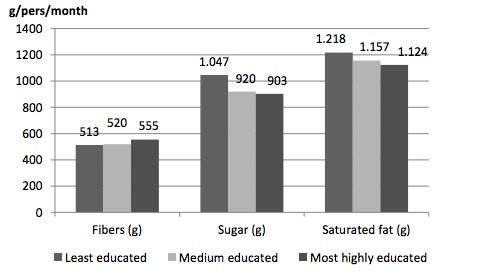
So they turned to a dataset, provided to them by the market-research firm GfK, that described the eating habits of roughly 2,500 Danes in great detail. The data tracked everything from a consumer’s education level to whether the milk she was buying was whole, low-fat, skim, or chocolate. Smed and Hansen’s first finding was that the Danes matched with previous patterns encompassing education level and diet: While everyone could stand to eat less sugar and saturated fat, it was the least-educated who were exceeding recommendations the most.

Monthly Consumption of Fiber, Sugar, and Saturated Fat, by Education Level
Note: “Highly educated” more or less refers to a bachelor’s degree, “medium” to an associate’s degree, and “least” to no higher education. (Smed and Hansen)

Because the dataset they were working with was so fine-grained, Smed and Hansen essentially got to look at the grocery-store receipts of all those Danish shoppers. They realized that this could let them do something that was potentially very revealing of why eating habits vary by education levels. Their method is a bit complicated, but the idea is that a shopper’s overall monthly spending hints at how much she was willing to spend for all of the, say, saturated fat she consumed in a month (which says something about how healthy or unhealthy she perceives saturated fat to be). Meanwhile, the money she spent on milk during a month hints at how much money she’s willing spend on saturated fat in milk (which says something about her preference for milk specifically, as opposed to other foods). In other words, Smed and Hansen’s analysis let them use shoppers’ spending records to draw conclusions about how they perceived both the nutritional value and the taste of different nutrients.


What they found was striking: Those with the most education and those with the least education had extremely similar understandings of how healthy (or unhealthy) sugar, fiber, and saturated fat were. But the big difference between these two groups was that more-educated people liked the taste of more-nutritious foods—foods lower in sugar, lower in saturated fat, and higher in fiber—than less-educated people.

How Education Level Correlates With Perceptions of How Healthy a Nutrient Is, and If It Tastes Good
Note: “Highly educated” more or less refers to a bachelor’s degree, “medium” to an associate’s degree, and “least” to no higher education. (Smed and Hansen)

This pattern is hard to accept at first, because it goes against the way a lot of people think about nutrition: The reason that more-educated people have healthier diets may not be because they have more of an appreciation for the importance of a good diet, but because to an extent they’re following their palates. This explanation undoes a basic assumption about healthy eating—that for everyone, a better diet is a matter of overcoming the temptation of salty, sweet, and fatty foods.
Instead, better-educated people might be being somewhat indulgent and pleasure-seeking when they buy food. They just happen to have a preference for different sorts of foods—foods they might have been exposed to when they were growing up.
* * *
When taken together, Daniel’s research and Smed and Hansen’s research suggests that any sound model of healthy eating should account for the strong possibility that the tastes children acquire in early childhood go on to shape their shopping habits later in life—and that acquiring those tastes in the first place can be more costly than it seems.
Public-health messaging often emphasizes the health benefits of eating certain foods. But if eating well is a matter of taste (and, of course, access), then those billboards and commercials may be missing the point.
It’s not clear exactly how public policy could change to accommodate all this, but Daniel has some ideas. She heard from some of her interviewees that when children were given fruits they’d never heard of at school, such as pomegranates and Asian pears, the parents started buying them at home. Perhaps schools could absorb the upfront losses that low-income parents worry about when feeding their children novel, but healthy, foods. (Smed and Hansen also mention this possibility in their paper.) And if policy solutions don’t materialize, Daniel notes that buying frozen produce can reduce waste, since it can be stored for long periods of time and doled out in small servings.
In the end, though, it seems like the most important thing a parent can do is to keep repeating a timeless three-word phrase, even after a string of rejections: “Eat your vegetables.” Research, and thousands of years of human experience, suggests that eventually, they will.