Thursday, April 27, 2017

New study finds 33 percent of seafood in six D.C. restaurants were mislabeled -- although usually with closely related species.
Credit: PeerJ
Scientists at the George Washington University used a powerful genetic technique to test seafood dinners sold in six District restaurants and found 33 percent had been mislabeled -- although in most cases with species that are either closely related or considered acceptable alternatives for menu listing.
Previous studies in other cities have shown widespread seafood substitution in which consumers are sold a completely different fish or sushi from the one listed. Those studies have indicated that seafood may be mislabeled as often as 26 to 87 percent of the time.
And in egregious cases, an unsuspecting diner is sold an expensive Tuna that is actually a completely different species of fish, often one that is much cheaper or on the endangered species list, says Keith Crandall, PhD, director of the Computational Biology Institute at George Washington University's Milken Institute School of Public Health (Milken Institute SPH) and leader of the new study , which was published in PeerJ.
Crandall and his team wondered if DC diners were getting what was listed on the menu. To find out, his team used DNA barcoding to test 12 seafood samples purchased in six restaurants and found that all in all they were doing a pretty good job.
"Diners that ordered tuna got tuna -- although maybe a slightly different type of tuna," says Crandall. "We didn't see the kind of outright seafood fraud that has been reported in other cities."
For this study, Crandall recruited GW graduate student David Stern to embark on a dream assignment. Stern and his wife visited six popular DC eateries and ordered seafood dinners that caught their fancy. Not only did the two get to dine out at restaurants offering up such tasty fare like Crusted Albacore Tuna or Pesto Chilean Sea bass but Crandall instructed them to bring back the bills -- he'd pick up the tab.
Stern and his wife ordered 12 seafood items on the menu but before diving into their food, they snipped off a small sample, stored it in a test tube, and brought it back to the lab. Stern then used DNA barcoding to identify a telltale region of the Cytochrome Oxidase I mitochondrial gene. This technique compares the seafood sample with a database of DNA barcodes from known species to identify it.
Of the 12 samples the research team found four menu items, one "Chilean Sea Bass" two "Tuna" and one "Rock Shrimp" had been mislabeled.
Other studies have found many instances in which restaurants swap out the item listed on the menu for a species that is endangered or threatened. But the GW team found only one sample with a conservation concern. The team's DNA barcoding analysis of the "Everything Tuna" sample identified it as Thunnus obesus, a species of tuna that is listed as "Vulnerable" by the International Union for Conservation of Nature's Redlist.
The substitutions in this study were all closely related species to the menu item or a legally acceptable swap, Crandall notes. Still, swapping out seafood does a disservice to customers who are either trying to avoid species that are endangered or are paying a higher price for a species they think is a delicacy, he says.
For example, the researchers found that one DC restaurant had listed Rock Shrimp on the menu but DNA barcoding showed it was actually serving Whiteleg shrimp. Whiteleg shrimp are typically found in aquaculture farms and are not as flavorful as deep-water Rock Shrimp.
This study, and others like it, cannot pinpoint where the swap occurs. Crandall says that buyers for restaurants can inadvertently purchase mislabeled seafood. For example, substitution of a cheaper fish for a more expensive species can happen anywhere along the food chain from the fishing boat to the fishmonger or the restaurant, he says.
In response to past reports of seafood fraud, DC and other cities passed legislation aimed at protecting the consumer. In the District, the Consumer Protection Act allows patrons to purchase samples of food or other goods for the express purpose of testing their identity.
"For the most part, our study found that DC diners with a craving for seafood are getting what they paid for." Crandall says.

No Unicorn Fraps here! Starbucks is set to open a 'fully sensorial' four-story 'Roastery' on Chicago's Magnificent Mile - complete with custom-brewed coffee and freshly-baked bread

  • The Seattle-based chain announced the opening of a new location Wednesday
  • Chicago's Starbucks Reserve Roastery is set to open in 2019 on the retail street
  • There is already a similar location in Seattle that opened in December 2014
  • Customers can pick between several types of brewing methods such as the siphon or the pour-over
  • New location will have on-site baking courtesy of Italian baker Rocco Princi, with whom the chain partnered in 2016 
Starbucks might have made Instagram history with its highly social-media-worthy Unicorn Frappuccino - but the chain has apparently retained some commitment to proper coffee.
The Seattle-based coffee giant announced on Wednesday it would open a glamorous new location on Chicago's upscale Magnificent Mile.
Starbucks' new Reserve Roastery is set to open in 2019 on the busy retail corridor. It will be the second of its kind, since the chain opened its first Roastery in Seattle in December 2014.
Gourmet: Starbucks announced Wednesday it will open an upscale location on Chicago's glamorous Magnificent Mile (pictured) focused on small-batch coffee
Experience: The chain already has a similar location in Seattle (pictured) where customers can pick between various brewing methods after a chat with a 'coffee specialist'
In lieu of the sugary Unicorn Frappuccino, the chain plans to dedicate the new location to custom-brewed coffee and has promised to partner with an Italian baker famed for his bread to provide freshly baked goods.
The four-story, 43,000-square-foot Roastery, described by Starbucks as a 'fully sensorial coffee environment', will serve small-batch coffee that will be roasted, brewed and packaged on the premises.
It will be located on North Michigan Avenue and Erie Street in the famous shopping area, where more than 460 retailers have settled.
After a chat with a 'coffee specialist', customers will also be able to pick between various brewing methods, such as the siphon or the pour-over, as is currently the case at the Seattle location. 
Artisan: The Roastery, described by Starbucks as a 'fully sensorial coffee environment', will serve  coffee that will be roasted, brewed and packaged on-site (pictured is the Seattle shop)
Artisan: The Roastery, described by Starbucks as a 'fully sensorial coffee environment', will serve coffee that will be roasted, brewed and packaged on-site (pictured is the Seattle shop)
Different: Starbucks' promises for its new promises seem to depart from the highly Instagram-worthy Unicorn Frappuccino, which didn't even contain coffee (pictured is the Seattle shop)
Starbucks is also stepping up its food offerings by partnering with Italian baker Rocco Princi. The coffee chain invested in Princi's namesake company in July 2016, and he has now been tasked with providing on-site baking in all Roastery locations for breakfast, lunch and dinner.
Howard Schultz, Starbucks' executive chairman, said Chicago was a 'very special city' for him because it's where the chain opened its first location outside of Seattle almost 30 years ago.
Another Roastery is scheduled to open in 2018 in New York City, with plans to unveil more locations in Shanghai late this year, as well as in Milan and Tokyo in 2018.
Ultimately, Starbucks is looking to open 20 to 30 Roastery locations around the world - a microscopic amount compared to its 24,000-plus regular coffee shops. 


Read more: http://www.dailymail.co.uk/femail/article-4453078/Starbucks-open-glamorous-location-Chicago.html#ixzz4fUrSTwRA
Follow us: @MailOnline on Twitter | DailyMail on Facebook

Effective trade investment: Critical Elements for Your Strategic Plan

 
By: Don Baker, Andy Buteux and John Wildman
DOES YOUR ORGANIZATION have an effective trade investment strategy? Given Trade’s sizeable impact on the P&L, most would answer, “Of course we do.” Then we ask to see the proof.
If we were talking about effective planning around activities related to Cost of Goods Sold, we’d expect to be shown plant layouts, line configurations, proposed formula changes, increasing throughput, eliminating waste, and detailed distribution planning.
However, it’s quite uncommon to see either the underpinnings or the application of such thinking behind the Trade line. Sure, there are data and PowerPoint presentations. But many of the facts don’t lead to conclusions; and many disparate insights don’t lead to changes in direction.
What would constitute an excellent strategy? For starters, collaboration between the P&L owner, marketing, sales and the trade marketing team on five strategic elements. These are simple in concept but challenging to implement in daily management:
  1. Solid Portfolio Plans
  2. Customer Segmentation with Channel Focus
  3. Price Architecture
  4. Supply Chain Impact on trade
  5. Fund Design
Each of these elements enables the overall plan and allows a company to invest in the face of ever-increasing competitive pressure and customer concentration.
Portfolio Plan. A clear Brand and Category investment strategy must outline the growth of the company’s brands. Just as importantly, and it should also outline expectations for the category. Brands should be valued across the company portfolio.
Customer Segmentation with Channel Focus.  This discipline should be in place and actually used to drive decisions. Many companies take an academic approach to this exercise, which can mean no one understands how the outcome became the outcome. It is crucial to maintain a living document that represents today’s reality with tomorrow’s plan for customers. Segmentation should be used to identify the winners and also those in the “on deck circle” who are performing well but are underdeveloped.
Price Architecture.  An everyday price and promotion strategy should articulate the value of the Brand/Segments/Items within the category. This document should house clear price/promotion guidelines for your own items as well as gaps and key price thresholds with respect to competitive items.
Supply Chain Impact. Many companies proficiently purchase commodities for COGS targets, but few deal with cost variances effectively. Organizations forecast finished goods and react, but many don’t monitor raw to finished good forecasting from a pricing and material availability perspective. So a broader plan for monitoring COGS variances and trade investment together is a critical practice.
Fund Design. Funding strategy is the key expression of how the first 4 elements are brought to marketplace. What performance-based funds are required to deliver your business objectives based on your brand’s key business drivers?
This list may seem fairly straightforward, but there are many hands are in the cookie jar! Not to mention the many silos among the constituents. Now is a good moment to take stock: How do the Trade Investment Strategic Pillars look at your company?

Is globalisation good for food?

Is globalisation good for food? The currently contentious concept of globalisation has impacted agricultural practice significantly. The question is now – are these changes positive or negative?
globalisation-food
Globalisation as a concept is going through a difficult period in light of the recent global political events.
The world benefits from a global food supply chain and quinoa is an empirical example. Not only do Peruvian farmers financially benefit from rising consumer demand in richer countries for the grain, as detailed by a study conducted by Marc Bellemare of the University of Minnesota, the local economy strengthens as the success quinoa farmers have more purchasing power and buy more products from their surrounding Peruvians.
There are worries that the increasing demand for quinoa, avocado and many other so-called superfoods largely attributed to increased consumer health consciousness in Europe and North America has made these foods too expensive for locals. The argument against this is that the overall prosperity distributed to the region outweighs the price increase of a singular product.

Sharing is caring

The world has a far more varied diet. Tourism and the global sharing of information has encouraged Chinese tourists to return demanding Yorkshire puddings and French cheeses and British citizens now expect to find a Thai restaurant in most towns. You’d like to think that this broadens both culinary and cultural horizons and intercultural tolerance as a result.
The main benefit of globalisation however, is the sharing of agricultural and production practice and consequently of efficiency across borders. Child malnourishment is at an all time low and still in decline which might be attributed to a global modernisation of agriculture and food production. While this modernisation process undoubtedly differs disproportionately according to continent and country and its respective wealth, the overall positive benefit is a global one. 
The sharing of farming techniques and machinery has enabled the world to largely feed a significantly increasing population and while the work is far from done, globalisation has allowed for more consumer choice and more efficient production practice, aiding the fight to ensure food security and global human health. 
Issues such as the spread of obesity and unhealthy diet as a result of globalisation and the invasion of multinational food corporations is a worry, particularly in Asia. That said, once solutions become more politically successful and widely implemented in the regions they first developed, such as North America and Europe, these too could theoretically be shared worldwide. 

Wednesday, April 26, 2017

From Diapers to Soda, Big Brands Feel Pinch as Consumers Pull Back

By Sharon Terlep, Jennifer Maloney and Annie Gasparro  Features Dow Jones Newswires
 
The biggest sellers of consumer products from soda to diapers are sounding a cautious note on shopper spending amid broader retail woes.
Executives from Procter & Gamble Co., PepsiCo Inc. and Nestlé SA said slowed spending in the U.S. cut into results in the most recent period, though they don't all agree on the reasons. Several said they expect business to pick up later in the year.
Some blamed the weak start of the year on higher gas prices, bad weather and other external factors, while other executives pointed to shifting consumer tastes. Analysts say some big brands, such as Gillette and Yoplait, are losing ground to upstarts. Overall purchases of consumer packaged goods in the U.S. declined 2.5% in unit terms in the first quarter, according to Nielsen.
"There is probably more sources of volatility today that at any other time in history," P&G Chief Financial Officer Jon Moeller said Wednesday in a call with reporters.
The most recent period was P&G's weakest of the fiscal year as organic sales -- a closely watched metric that strips out currency moves, acquisitions and divestments -- increased just 1%.
Mr. Moeller said consumers are cutting back purchases, aggressively seeking deals and drawing down supplies at home. At the same time, he said, a growing affinity for beards has played a big part in driving down razor sales, which contributed to a 6% organic sales decline for P&G's grooming unit.
Although pricing increases helped PepsiCo post growth in its beverage and snacks businesses in its latest quarter, sales declined in its Quaker Foods North America unit, which sells grocery staples such as Rice-A-Roni, Aunt Jemima and its namesake oatmeal.
PepsiCo, like big food rivals Kraft Heinz Co. and Nestlé, is struggling as consumers shift away from diet sodas and processed foods to fresher and healthier options. It has launched new products, such as a premium bottled water brand, to adjust to the shift.
"Our next challenge is how do we leverage our relationships with retailers to reinvent the center of the store?" said CEO Indra Nooyi on a conference call Wednesday. "And we need to do that in order to bring interest back to that whole cereal aisle and therefore, Quaker."
For food and nonfood staples, big brands are struggling more than the overall industry. The 20 largest consumer packaged goods companies last year had flat sales while smaller ones posted sales growth of 2.4%, according to Nielsen.
Wal-Mart Stores Inc., meantime, has been reducing inventories and slashing prices as it fights to compete with Amazon.com Inc. and European discounters moving into the U.S. Those cuts are eating into its own profit and, in turn, leading the world's biggest retailer to put pressure on its vendors.
Kimberly-Clark Corp. this week reported its first quarterly organic sales decline in 13 years driven largely by falling demand in North America. The maker of Kleenex tissues and Huggies diapers lowered its forecast for the year but said it expects better performance as the year progresses.
Nestlé Chief Executive Mark Schneider said weak U.S. demand isn't an issue isolated to Nestlé and that it reflects a breakdown in the usual relationship between economic growth and consumer spending. At the same time, he said, intense competition is making it harder to push through price increases.
"In spite of good economic data we are seeing a large amount of uncertainty" in the U.S., Mr. Schneider said last week on an investor call. "When that uncertainty subsides it will be good news."
While growth is stronger outside the U.S. for many companies, foreign markets also are rife with volatility. P&G said everything from the Brexit in Europe to political uncertainty in developing markets has made for bumpy times in overseas operations.
The dynamics are driving tough choices for companies as they are forced to decide between reducing prices and ceding market share. PepsiCo and Coca-Cola Co. have been shrinking packages and raising prices. P&G has been lowering prices in some of its biggest categories such as diapers and razors, forcing down prices of rivals as well.
"Don't ask me who started it," Kimberly-Clark Chief Executive Thomas Falk said of price wars in consumer products. "Everybody thinks it's the other guy."
Procter & Gamble Co. and PepsiCo Inc. posted lackluster sales in the most recent quarter as producers of some of America's biggest consumer products struggle to give shoppers what they want.The two companies, which make everything from soda and chips to diapers and toothpaste, said Wednesday that slowed spending in the U.S. cut into their profits. The results highlight the challenges makers of food, beverages and other consumer staples are facing as they try to adapt to changing tastes. Analysts say some big brands, such as Gillette and Yoplait, are losing ground to upstarts.
Overall purchases of consumer packaged goods in the U.S. declined 2.5% in unit terms in the first quarter, according to Nielsen. Big brands are struggling the most. The 20 largest consumer packaged-goods companies last year had flat sales while smaller ones posted sales growth of 2.4%, Nielsen says. There are "probably more sources of volatility today that at any other time in history," P&G Chief Financial Officer Jon Moeller said Wednesday in a call with reporters.
U.S. economic growth slowed in the fourth quarter, and experts say the sluggishness continued into the start of this year. Economists surveyed by The Wall Street Journal are forecasting that gross domestic product, a broad measure of the goods and services produced across the economy, advanced by a tepid 1% in the first quarter from the previous three months.
That would mark a slowdown from the roughly 2% trend that has prevailed through most of the current expansion and which President Donald Trump is seeking to double. The U.S. Commerce Department releases its first read on first-quarter GDP on Friday.
Household spending has been healthy since the 2009 recession, helped by rising wages and falling gas and consumer prices. But much of the spending has been focused on home improvements, automobiles and entertainment.
Overall consumer spending in the first quarter was stymied by higher inflation in January and February and will likely pick up for the duration of the year, said Chris Christopher, director of consumer economics for IHS Markit. But he said companies that sell household staples face longer-term challenges.
"There are some behavioral changes: A lot more is going online, people are not getting married, they're living in smaller spaces, and they aren't having as many children," he said. "That's not going to turn around very fast." P&G's latest quarter was its weakest of the fiscal year as organic sales -- a closely watched metric that strips out currency moves, acquisitions and divestments -- rose just 1%.
Mr. Moeller said consumers are cutting back purchases, aggressively seeking deals and drawing down supplies at home. At the same time, he said, a growing affinity for beards has played a big part in driving down razor sales, which contributed to a 6% organic sales decline for P&G's grooming unit.
Although pricing increases helped PepsiCo post growth in its beverage and snacks businesses in its latest quarter, sales declined in its Quaker Foods North America unit, which sells grocery staples such as Rice-A-Roni, Aunt Jemima and its namesake oatmeal.
PepsiCo, like big food rivals Kraft Heinz Co. and Nestlé SA, is struggling as consumers shift away from diet sodas and processed foods to fresher and healthier options. It has launched new products, such as a premium bottled water brand, to adjust to the shift. "Our next challenge is how do we leverage our relationships with retailers to reinvent the center of the store?" said CEO Indra Nooyi on a conference call Wednesday. "And we need to do that in order to bring interest back to that whole cereal aisle and therefore, Quaker."
Overall for food and nonfood staples, big brands are struggling the most. The 20 largest consumer packaged-goods companies last year had flat sales, while smaller ones posted sales growth of 2.4%, according to Nielsen.
Anna Kunz, a 42-year-old painter, said she has started shopping for fresh produce and meat instead of canned or boxed food in recent years, because she wants her 13-year-old daughter to eat healthy. "Clean eating. That's what it's all about," she said at a grocery store in Chicago, with sugar snap peas and strawberries in her cart. She says that is much harder to do on a budget, and even though she is nervous about the economy, "It's health. You've just got to do it."
While 17% of U.S. consumers reported an improvement in household financial conditions over the past six months, it wasn't enough to trigger higher spending, said John Baumgartner, a food analyst at Wells Fargo, based on its quarterly consumer survey. Respondents also reported a 21% rise in eating leftovers at the expense of grocery purchases.
Hershey Co., which reported lower-than-expected sales growth Wednesday, said people are snacking more often, but U.S. food retail trends are "choppy" overall, perhaps exacerbated by delayed tax refunds and more online shopping. The chocolate giant lowered its sales forecast for the year "given the uncertainty regarding overall U.S. brick-and-mortar retail trends."
Wal-Mart Stores Inc., meantime, has been reducing inventories and slashing prices as it fights to compete with Amazon.com Inc. and European discounters moving into the U.S. Those cuts are eating into Wal-Mart's own profit and, in turn, leading the world's biggest retailer to put pressure on its vendors.
Kimberly-Clark Corp. this week reported its first quarterly organic sales decline in 13 years, driven largely by falling demand in North America. The maker of Kleenex tissues and Huggies diapers lowered its forecast for the year but said it expects better performance as the year progresses.
Nestlé Chief Executive Mark Schneider said weak U.S. demand isn't an issue isolated to Nestlé and that it reflects a breakdown in the usual relationship between economic growth and consumer spending. At the same time, he said, intense competition is making it harder to push through price increases.
"In spite of good economic data, we are seeing a large amount of uncertainty" in the U.S., Mr. Schneider said last week on an investor call. "When that uncertainty subsides it will be good news."
While growth is stronger outside the U.S. for many companies, foreign markets also are rife with volatility. P&G said everything from the Brexit in Europe to political uncertainty in developing markets has made for bumpy times in overseas operations.
The dynamics are driving tough choices for companies as they are forced to decide between reducing prices and ceding market share. PepsiCo and Coca-Cola Co. have been shrinking packages and raising prices. P&G has been lowering prices in some of its biggest categories such as diapers and razors, forcing down prices of rivals as well.

Tuesday, April 25, 2017

The Oldest Grocery Delivery Company Aims to Take a Bite Out of the Big Apple

By . Published on .
Peapod debuts New York campaign.
Peapod debuts New York campaign. Credit: Peapod
Before there was Instacart, AmazonFresh, and FreshDirect, there was Peapod. Founded in 1989 as a service where customers could phone in their orders, the online grocer has grown to command a significant portion of the growing food delivery market—which is expected to reach $100 billion in sales by 2025, according to a recent report from Nielsen and FMI. Part of Peapod's promise is the financial backing of parent company Ahold Delhaize, which acquired it for $35 million in 2001. Along with using its own warehouses, Peapod can also tap into the supply chains of Ahold Delhaize's brick-and-mortar chains, like Stop & Shop and Food Lion.
"There are a lot of shiny new players right now that are doing what we did in the first two years, but it's not sustainable and inefficient," said Carrie Bienkowski, who joined Peapod as chief marketing officer three years ago from eBay. "Because we're part of a bigger brick-and-mortar operation, it's enabled us to expand quickly."
Of course, Peapod's dilemma is that the Skokie, Ill.-based company lacks the brand awareness of its trendier new competition. Beginning this week, the company plans to change that with a new marketing campaign designed to expand its presence in the New York City regional market, which currently accounts for about a quarter of sales. Later this year, Peapod will debut a more universal campaign to boost its brand.
Delivering food and meeting temperature and expiration requirements can be a difficult and expensive business, and one that Peapod has spent decades mastering, unlike Amazon and other new entrants to the category, who are still learning the ropes.
"Peapod may be old school, but they do execution 100% well. They trained their people to be food experts," said Phil Lempert, founder of Supermarket Guru, which analyzes the grocery space. "Their problem is branding."
The Big Apple push, tagged "The Grocery Store at Your Front Door," will include print and digital display advertising, as well as subway takeovers at two Brooklyn locations in May and a delivery truck design contest challenging artists. Peapod, which doubled its business in Brooklyn last year and recently opened a Jersey City warehouse, tapped Southfield, Mich.-based Doner for the campaign. 360 handled PR, social and digital.
"We wanted to talk to New Yorkers like New Yorkers—be relatable and touch on the frustrations of everyday lives," said Karen Cathel, exec creative director at Doner, noting that the resulting campaign touches on the hardships of urban life, like how much groceries weigh.
Though Beinkowski declined to say how much Peapod is spending, she noted that it's the most expensive effort the brand has ever had for a single market push. Last year, Peapod spent about $1.5 million on measured media in the U.S., according to Kantar Media.

Monday, April 24, 2017

CVS Boots Bad-For-You Items to Make Room for Healthier Products

FacebookTwitterLinkedIn
CVS Health - new store design reveal 2017
At a time of a vast seachange in retail, with brick-and-mortar chains closing almost weekly, CVS is trying to stay ahead of trends by insuring that its stores not only survive the turmoil but take advantage of the opportunity to better serve customers. In the wake of booting tobacco from its stores, it’s on a drive for growth by removing more unhealthy ingredients to make room for “better for you” products, services and information to help people be in charge of their health and wellness.
A big part is the makeover it just revealed to its stores, with a transformative new physical experience rolling out that reflects consumers’ demands for healthier lifestyles. Just as tobacco was booted from its check-out counter in 2014, candy is exiting the check-out area to be replaced with healthier snack options.
Promoting the health part of its corporate CVS Health name, it’s creating a more seamless digital integration with its in-store health clinics—plus many more changes that will continue improving the optics for the brand (quite literally).
Now you can get your eyes evaluated and purchase glasses at select @cvspharmacy locations. Love the frame selections!  
 
Coming soon! Schedule future MinuteClinic appts, making it even more convenient for you to receive top-notch 
 
The chain is rolling out a “reimagined store format” that emphasizes healthier food and beverage brands, featuring more of them than ever before; selling more supplements and vitamins; more informative signage and materials to guide customers to the most helpful solutions by displaying products together in areas such as sleep, immunity and “connected health.”
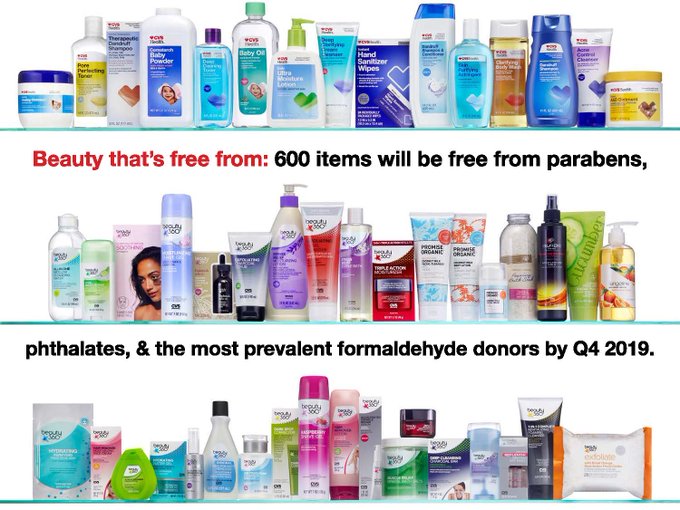
In addition to highlighting what it’s selling and the benefits of its offering, the new design is also an opportunity to showcase what it isn’tinterested in selling: products with parabens, phthalates and “the most prevalent formaldehyde donors.” It’s also eliminating transfats in its private-label store brands.
We're removing parabens, phthalates & most prevalent formaldehyde donors across ~600 beauty and personal care items https://cvs.co/2pj1yKy 
 
CVS executives are still navigating its post-tobacco era, following the company’s 2014 decision to quit selling tobacco—a watershed event referenced in its latest press release about its new store experience platform. CVS call its decision to quit tobacco “the catalyst” for the evolution of its retail stores that began in 2015 with healthier food selections and an enhanced “beauty environment.”
“As we thought about what was next,” CVS states, “we knew we needed to leverage our expertise in health—and bring our purpose of helping people on their path to better health—to life in our retail environment.”
The chain also has been pleased with financial returns from the health-elevated offerings and store-design changes that it began making a couple of years ago. For the 400 stores with versions of the new design, sales increased in consumables, beauty and health.
.@CVSPharmacy introduces new products that blend health & beauty so customers look & feel their best! 
 
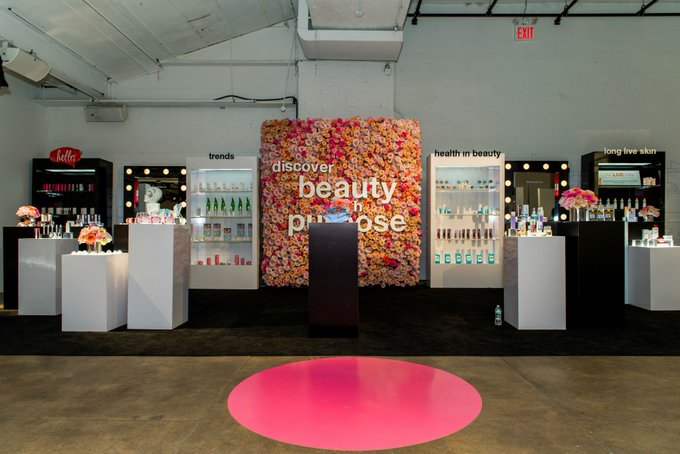
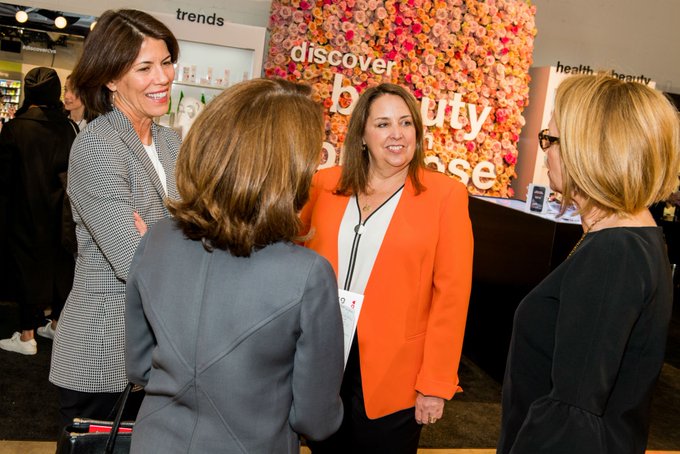
CVS showed off the evolution of the concept in an event held April 20th at The Garage in New York where it invited partners, brands, press and bloggers to check out its new design focus and innovations.
Today, our CVS Ambassadors are getting a sneak peek of all things new at @CVSPharmacy
 
@cvspharmacy wants you to not only focus on treating your skin, but also protecting it! Ad  
 
Its goal is to drive growth in categories that are most closely related to its new health-related purpose and expertise while delivering an unparalleled shopping experience, according to Drug Store News. 
CVS Health - new store design reveal 2017
The new format includes 100 feet of new merchandise in health, beauty and healthier food and uses a streamlined layout to highlight themes that make shopping easier. The new items include a broader selection of vitamins and supplements, on-trend beauty brands including Wunder2 and Tigi Cosmetics, beauty products with more skin-health benefits and more natural ingredients, and better-for-you foods such as Epic meat bars and That’s it fruit bars.
CVS Health - new store design reveal 2017
CVS will merchandise its new offerings differently, creating a “trend wall” (such as the one above) at 2,000 stores to highlight product launches and niche brands, curating and grouping solutions for consumer needs such as “immunity” products in “discovery zones” throughout the store that are specially merchandised and that provide especially helpful signage.
CVS Health - new store design reveal 2017
The company is rolling out the changes in as many as 70 new and existing stores this year with plans to expand to several hundred more in 2018.