Tuesday, November 28, 2017

European-Owned Apparel Stores Offer Grocers Supply Chain Inspiration

By Jenny McTaggart – 11/21/2017
Fashion-forward European-owned clothing stores may be the last places that most supermarket executives would look to for inspiration. It turns out, however, that some of these retailers are right on point with their supply chains — especially in the areas of analytics, planning and ecommerce execution.
Two multinational clothing companies — Inditex, which owns the Zara brand, and H&M — were featured in the 2017 Supply Chain Top 25 list of retailers published earlier this year by Stamford, Conn.-based Gartner Inc. (Walmart and CVS were the only grocery-related companies to show up in the top 10). Spain-based Inditex was recognized for bringing product to market in as little as two weeks, as well as for its improved omnichannel demand-planning capabilities, while Sweden’s H&M was lauded for its embrace of automation and warehouse management technology.
Mike Griswold, a research VP at Gartner, tells Progressive Grocer that these clothing companies, as well as the other nonfood retailers that were recognized by Gartner, are doing several things that supermarkets can most definitely learn from. At the most basic level, the top performers have recognized that their supply chains are vehicles to support company growth. Beyond that commitment, though, there are other important areas on which they’ve focused.
Perhaps most importantly, these leading retailers are embracing the use of data to drive their decisions, notes Griswold. He urges food retailers to follow suit and “strive for advanced analytics capabilities” themselves.
“With the wealth of data that food retailers possess — POS transaction data, loyalty data, etc. — they are in a unique position to gain very granular understandings about their shoppers,” he says. “This can drive incredible opportunities in personalization of promotions, prices and assortments.”
Echoing Griswold, David Marcotte, SVP of retail insights at Boston-based Kantar Retail, says that he believes there’s an untapped amount of data that grocers could be taking advantage of, especially in relation to improving their business planning. “Understanding data flows and being able to correct triggers against it, which has been a big part of the last 20 years of supply chain management, definitively needs to step up again,” he advises.
In fact, Marcotte has been taking a page from the fashion industry himself, telling his grocery clients that they should be looking harder at what he refers to as “formalized merchandise planning.”
“Merchandise planning in the CPG context is seasonal,” notes Marcotte. “It means asking, ‘What are we going to do for Easter? We’ll spend X amount on candy, and at the end of the season, we’ll reduce the price, and then if it’s still on the shelf, we’re going to reduce the price by 90 percent.’ Merchandise planning in apparel goes all the way back to Bangladesh, to the type of fabric the manufacturer is using, the type of weave, the quality standards they’ve established — what’s called a bill of material.
“The reason I keep advising this as a supply chain alternative is because in a formalized merchandise-planning scenario, every step of the supply chain matches up directly to a line item in the actual budget of the company,” he continues. “In grocery, that linkage between an activity in the supply chain directly to the P&L doesn’t exist.”
Although he points out that merchandise planning is a skill typically taught in college retailing programs that have little to do with the grocery business, Marcotte says that supermarket operators would do well to think more along those lines.
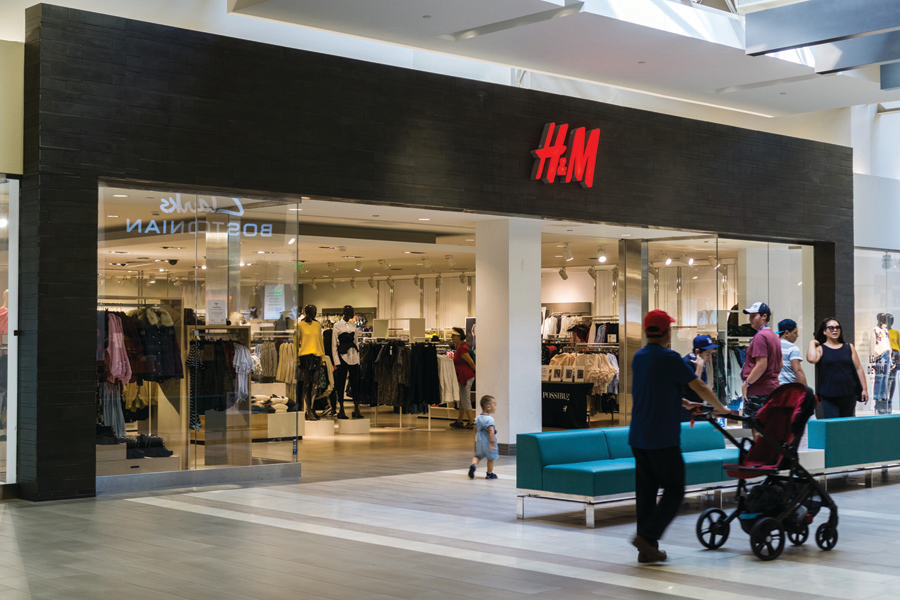
H&M and Zara (at top) are ramping up their omnichannel strategies by letting customers pick up or return online purchases in-store, as well as accepting mobile payments.

PLANNING FOR CURVEBALLS

One reason to be more closely focused on every step of the supply chain is that nowadays, business planning has become even more complex, notes Marcotte. In grocery distribution, it’s difficult enough to deal with unpredictable traffic snarls or a sudden summer storm that dampens a retailer’s promotions around July 4th cookout plans. Yet other factors that may not be on retailers’ radar — such as climate change and even politics — can really throw a curveball into short- and long-term planning, he says.
In these instances, a broader, global outlook (like the ones taken by multinational fashion chains) could benefit U.S.-based retailers, according to Marcotte. “The supply chain is not limited to the United States,” he observes. “Given the amount of product that comes in through seaboard and in container traffic … if companies don’t have some understanding of that, their ability to function properly is limited.”
Additionally, politics can play into trade agreements, as currently seems to be the case.
“Mexico has cut back on their futures orders for corn, meat and pork, not so much because they’re angry with the U.S., but because they can’t predict what 2018 is going to look like,” explains Marcotte. “A whole host of new trade agreements are being arranged, basically powered off of what’s going on in Mexico, that are changing how food product is moving globally. It’s serious.”
Politics also came up as a hot topic in Gartner’s top 25 ranking. Stan Aronow, a research VP at Gartner, noted in the accompanying report that “today’s supply chain leaders face a much different business environment than just 12 months ago. A general trend toward protectionism, as evidenced by Brexit and the policies of the current U.S. administration, have caused some companies to shift supply chain network design decisions and create contingency plans in anticipation of new trade policies. Continued investment in innovative supply chain capabilities will be required to meet this changing landscape.”

OMNICHANNEL EXECUTION

Aside from politics, omnichannel execution remains a key theme among the leading supply chain innovators. The chairman and CEO of Inditex, Pablo Isla, said earlier this year that his company seeks to have “full integration of the brick-and-mortar stores and online businesses, with store openings that are increasingly more relevant.” The company has chosen to close some of its smaller units and focus on flagship stores instead, and shoppers can easily return items purchased online in its stores or make online orders in-store with associates’ assistance.
Meanwhile, Gartner’s Griswold urges grocers to “ramp up their unified commerce execution capabilities at store level as quickly as possible.” Store-level fulfillment will continue to grow as retailers strive to shorten fulfillment windows and work toward more same-day and next-day capabilities, he asserts.
Last but not least, Griswold says that grocers need to figure out their talent requirements and move quickly to “fill the gaps. Food retailers would be smart to strengthen their partnerships with colleges and universities that have strong supply chain programs,” he advises, “and they need to recognize that as they look to build their analytics capabilities, they will need to rely on more data scientists and data engineers.”
Kantar Retail’s Marcotte concurs.
“You can use third parties for technology, data and the ability to create first-line analytics, but if you don’t have a skill inside the box that understands what that is, what that produces and what impact it has inside your company, you won’t get that from a third party,” he notes. “In the better retailers, executives sometimes notice that talent from within, and quickly move the right person from aisle A to the office.”

IMPORT SHARE OF FRUIT STILL GOING UP

Imports continue to represent a rising percentage of fresh fruit consumed in the U.S.
Excluding bananas, imports made up 38.5% in percent of all fresh fruit consumed in the U.S. in 2016, up from 37.7% in 2015, 23.3% in 2010 and 20.1% in 2000.
Including bananas, 53.1% of all fresh fruit consumed in the U.S. is imported, up from 49.1% in 2010 and 42.4% in 2000.
The U.S. Department of Agriculture reportshows that imports accounted for 85.9% of fresh avocados consumed in the U.S., up from 73.4% in 2010 and 25.7% in 2000.
Imports represented 12.2% of total consumption of fresh oranges in 2016, compared with 7.8% in 2010 and 3.1% in 2000.
Imported grapefruit represented 5.7% of total consumption in 2016, up from 3% from 2010 and 0.9% in 2000.
The percent of total consumption represented by imports for other commodities for 2016 includes:
  • Apples: 6.3%;
  • Blueberries: 57.2%;
  • Cherries: 7.7%;
  • Grapes: 49.8%;
  • Kiwifruit: 82.1%;
  • Peaches and nectarines: 11.1%;
  • Pears: 18.1%;
  • Plums: 22.5%;
  • Raspberries: 48.4%;
  • Strawberries: 14%;
  • Grapefruit: 5.7%;
  • Lemons: 13.4%;
  • Oranges: 12.2%; and
  • Tangerines: 30%.

The quest to improve online grocery profitability: Learning from Walmart & Hy-Vee

The quest to improve online grocery profitability: Learning from Walmart & Hy-VeeWalmart’s decision to test charging higher prices for products sold online vs. in-store is good news for the future of supermarket online sales even if it runs the risk of slowing growth – something that’s very important to the company.
Shoppers have shown they want to buy groceries online. BMC research from 2017 finds that about 24% of consumers are buying groceries online on a monthly basis, and that number is increasing steadily. If grocers don’t offer this service, they risk losing the business – but the challenge is that executing online orders costs more so profitability is lower.
Walmart’s willingness to trial higher prices may provide the cover for others to do something similar. In the meantime, here are two more things grocery retailers can do to improve the profitability of their online business.
1. INCREASE THE FEES FOR THE SERVICE. Hy-Vee recently changed its fee structure in the Des Moines market. Historically, Hy-Vee offered in-store pick up for $2.95 and home delivery for $4.95 for orders under $100 (fees were waived for orders over $100).
This fall they started charging for home delivery orders based on a premium given to shorter delivery time windows.
Delivery time windowOrders under $100Orders over $100
 4-hour
$5.99
free
 2-hour
$9.99
$7.99
 1-hour
$12.99
$9.99
While increasing the fees for delivery, HyVee dropped the order size required for free in-store pickup to $50.
2. ADD VALUE AND CHARGE FOR IT.  For example, for connecting the consumer directly with a personal shopper as they select the order. The start up Rappi.com is doing this in Latin America.

BMC POV

It’s critical that grocery retailers find ways to improve the profitability of their online business since they can’t afford to subsidize it.
Improved profitability will require finding ways to do some combination of:
  • Increasing transaction size
  • Reducing costs
  • Generating more income from higher prices and/or service fees
We were not able to confirm whether or not Walmart’s test is still running as of November 27 but the fact that they even tried it for a while opens the door to testing these and other ideas, as well.

Ocado’s Technology Lands in France

 
Ocado becomes Casino's solution provider2
Photo: Ocado/Murphy, Terry
In the UK, Ocado already provides IT and logistics services to support the fourth largest retailer, Morrisons.
British grocery e-commerce pure player Ocado is to provide French retailer Groupe Casino with its technology solution dubbed Ocado Smart Platform. In detail, Casino will get access to Ocado’s latest-generation automated warehouse as well as its front-end website functionalities, last-mile routing management, big data and real-time implementation.
The first beneficiary of this technology transfer will be the website of Monoprix, Groupe Casino’s urban premium supermarkets. Further, the agreement foresees the development, over the next two years, of Customer Fulfilment Centres using Ocado’s proprietary Mechanical Handling Equipment in the north-western part of France, including the Paris area. Both partners will also consider further developments close to other large urban areas.
Groupe Casino’s CEO Jean-Charles Naouri said: “This agreement is a major leap in terms of quality: 50,000 food items will be offered in the first stage to customers in the Greater Paris area with precise and speedy home delivery, and through a platform which makes it achievable to do this profitably.” Casino would pay undisclosed upfront fees for the technology, as well as ongoing fees for its utilisation capacity and the service provided.

Opinion

A Beneficial Agreement

Unsurprisingly, the problem of online grocery is the costs. The battle is therefore a technological one, one of who uses the best technology, processes and logistics. These are Ocado’s strong suit. It ranks as Europe’s fifth largest grocery e-commerce retailer in terms of retail sales in 2017, and is the only pure player in the Top 20, LZ Retailytics data shows. It relies solely on this channel and the cost-challenging home delivery fulfilment model. Its presence in one of the world’s early online-adopting markets gave Ocado time to invest significantly in its processes and refine its technology over the years.
This technological advance is therefore highly attractive to retailers willing to catch up with the tech-savvy leading pack, be it Groupe Casino, British Morrissons, as well as some other rumoured ones, such as Swedish ICA Gruppen. Indeed, improving semi-automated warehouses is a costly and time-consuming process, and Ocado’s insights help limit risks and speed up the go-live date. On Ocado’s side, it helps to amortise costly investments. One of the world’s largest retailers’ interest in its technology surely helps flexing muscles to its own investors, after years of loss making.
Even so, it’s not all roses. The company had shown strong international ambitions regarding its Ocado Smart Platform Solution, but the process has reportedly been dragging on. We also raise questions on Ocado’s long-term expansion vision as a retailer, beyond the UK, as it seems to be turning into a solution provider. The move underpins its lack of confidence in entering the neighbouring market of France, and coincidentally Europe’s second largest grocery e-commerce market, according to LZ Retailytics. Hurdles would be numerous: low penetration of home delivery fulfilment, a crowded market, as well as the lack of local logistics experts who would need to build something up from scratch, among others. Conveniently, most issues can now be solved by Groupe Casino. Quite a beneficial agreement indeed!

Report: Innovation continues to drive fresh produce sales


7 lessons from Cyber Monday

The online sales holiday raked in $6.6 billion — up 17% over last year — and showed the rising force of mobile in digital holiday sales.

Monday, November 27, 2017

Publix_GreenWise.JPG

Publix to expand GreenWise format to South Carolina

Second unit in banner reboot will be smaller than current GreenWise stores
Mark Hamstra 1 | Nov 27, 2017
The 25,000-square-foot location, which is the second new GreenWise the company announced this year as part of a reboot of the natural/organic banner, is scheduled to open in early 2019. Another GreenWise — the first in the planned revamp of the concept — is schedule to open in late 2018 in Tallahassee, Fla.
The South Carolina store would be smaller than the company’s current GreenWise stores, which measure about 36,000 to 39,000 square feet, according to Maria Brous, a spokeswoman for Publix. The company has not yet revealed additional details about the new version of the concept.
“We are committed to being the retailer of choice for consumers who are looking for specialty, natural and organic products,” said Brous. “Over the past several years, we have gained valuable insights from our existing GreenWise locations. By combining theselearnings with customer feedback and market trends, we are better positioned to deliver on our vision of being the best at serving the evolving lifestyles of today’s consumer.”
She said the company plans to share additional details related to the new GreenWise format closer to first store opening next year.
Publix began opening GreenWise locations, which were then seen as a vehicle to better compete against Whole Foods Market, in 2007. After opening three of the stores — in Boca Raton, Tampa and Palm Beach Gardens — Publix shifted gears and said it would focus on opening “hybrid” Publix stores that incorporated elements from the GreenWise format.
The South Carolina GreenWise will be located in the Indigo Square shopping center just east of Charleston.