Saturday, June 30, 2018

Walmart-Led Blockchain Effort Seeks Farm-to-Grocery-Aisle View of Food Supply Chain

The grocery giant, together with Nestlé, Dole and others, wants to set new industry standards on food tracking

A Food Trust trace of a shipment of strawberries in early December 2017 shows that they traveled from two distributors, in Clarksville, Ark., and Ochelata, Okla., to five Walmart stores.
A Food Trust trace of a shipment of strawberries in early December 2017 shows that they traveled from two distributors, in Clarksville, Ark., and Ochelata, Okla., to five Walmart stores. PHOTO: KIM S. NASH / THE WALL STREET JOURNAL
BENTONVILLE, Ark. — When bad food gets into the supply chain, regulators must figure out what went wrong, yet no company, industry group or government agency has a complete picture of how fruit, meat or other foods move from field to fork. Companies are required to record just a few steps in their supply chains and some still keep information on paper.
Now, a year after initial tests, 10 of the world’s biggest companies, including Walmart Inc. and Nestlé SA, are building a blockchain to remake how the industry tracks food worldwide. The so-called Food Trust aims to improve recalls, quickly identifying the issue and shrinking the time consumers are at risk. Business benefits such as avoiding losses from overly broad food recalls are also expected.
“You’re capturing real-time data at every point, on every single food product,” says Frank Yiannas, vice president of food safety at Walmart, which leads the effort. “It’s the equivalent of FedEx tracking for food.”
The Food Trust group, which also includes Dole Food Co., Driscoll’s Inc., Golden State Foods, Kroger Co., McCormick and Co., McLane Co., Tyson Foods Inc. and Unilever NV, wants to set new standards for the rest of the food industry. “We are competitors, yes, but working together to ensure the trust of consumers,” says Chris Tyas, global head of supply chain at Nestlé.
Blockchain, aside from enabling a cryptocurrency craze, has gained supporters in diverse industries. British Airways has tested the technology for tracking flights. Merck Inc. sees it as a way to share drug shipping data. Bank of America Corp. has patented blockchain inventions and some in the music business use it to secure artist rights.
Companies supporting the Food Trust blockchain, built with International Business Machines Corp., see the technology as a record-keeper to govern transactions with many hand-offs, preserving one consistent history, says Howard Popoola, vice president of corporate food technology and regulatory compliance at Kroger.
A paper ledger from the 1960s kept by Walmart founder Sam Walton, photographed at the Walmart Museum in Bentonville, Ark., April 6, 2018.
A paper ledger from the 1960s kept by Walmart founder Sam Walton, photographed at the Walmart Museum in Bentonville, Ark., April 6, 2018. PHOTO: KIM S. NASH / THE WALL STREET JOURNAL
Blockchain establishes authorship or ownership that experts say can’t be faked and eliminates costly middle layers because of its peer-to-peer structure. The encrypted data stays up-to-date on all participants’ systems.
The Food Trust project, still in development, comes too late to help in an ongoing investigation of romaine lettuce contaminated with E. coli bacteria that the Centers for Disease Control says has sickened at least 197 people in 35 states. With five dead, this romaine problem surpasses the then-historic 2006 E. coli outbreak tied to spinach in fatalities and geographic reach.
Walmart Inc. can trace packaged mangoes in seconds, improving the process of several days previously required.
Walmart Inc. can trace packaged mangoes in seconds, improving the process of several days previously required. PHOTO: KIM S. NASH / THE WALL STREET JOURNAL
So far, the system stores data related to 1 million items in about 50 food categories, according to IBM. That includes Nestlé canned pumpkin, Driscoll’s strawberries and Tyson chicken thighs.
Mr. Yiannas, strolling the produce aisle of a Walmart Neighborhood Market store here on a recent morning, picks up a container of sliced mangoes. In a blockchain test last year, he says,  his team traced a similar batch of mangoes from a Mexican orchard to a Walmart store in 2.2 seconds, Mr. Yiannas says. That’s much faster than the six days and 18 hours the trace-back took gathering data from paper, barcodes, and other sources, he says.
Food Trust, he says, aims to replace the industry’s current practice of “one step up, one step back.”
Current federal rules require that each player in the supply chain – such as a processing house or trucker – keep records about where it got food and where it sent food. In an illness outbreak or other problem, investigators from the Food and Drug Administration and elsewhere must contact companies that they think could be involved to try to recreate the journey of the suspect food. Researchers often hike through fields and inspect supermarket shelves for clues.
Legwork can take months and still leave holes. Eleven weeks after the CDC warned the public about an E. coli infection later linked to lettuce, authorities don’t know precisely where or how it started, other than it likely began in the growing region of Yuma, Ariz.
Investigators did learn that some romaine records aren’t electronic, says Stephen Ostroff, the FDA’s deputy commissioner for foods and veterinary medicine. He declined to comment on the role of paper information in the case but said a lack of data uniformity and the use of paper forms can slow trace-backs.
“Information is retained in a whole variety of ways, including on pieces of paper. Then somebody has to go find it and add to a database. That takes some time,” he says.
To help solve the paper problem, Food Trust offers a mobile app for farmers, pickers and others to enter data quickly onto the blockchain.
Still, challenges are emerging with Food Trust, says Mr. Tyas. Nestlé, with 2,000 brands and many suppliers and distributors, manages data on paper and with technologies that include barcodes and proprietary software. Technology and safety experts at Nestlé are working with Food Trust partners to build integration tools, he says.
A complete shift to blockchain by the food industry could take years, Mr. Yiannas acknowledges. But as products are added to Food Trust, traceability will outpace today’s romaine situation, he says. “Outbreaks don’t have to be this big and this long.”
Why Danone plans to buy up to 25 food startups

US (TX): Vertical farm introduces chemical-free produce line

Eden Green Technology, a next generation vertical farming company, has unveiled 'Crisply', a locally grown, freshly picked produce line. 

Eden Green Technology's Crisply produce, which is non-GMO and pesticide-, herbicide- and chemical-free, can be found in Walmart stores beginning in Texas next month.


"We are elated to make fresh, handpicked greens available to everyone who wants to eat high quality, nutrient-rich produce without spending an entire paycheck," said Jaco Booyens, co-chair of Eden Green Technology, a privately held Dallas-based company, which has been in stealth mode for two years.

"We pick our produce, package the same-day, and stamp the date when they are harvested on the package so consumers know exactly how fresh their salads are. We also make it possible for our retail partners to put our produce on their shelves immediately after they've been harvested, in some cases that same day. No other company does that," Booyens added.

Eden Green Technology's Crisply produce grows in greenhouses in proprietary vine-like systems. The company's technology encloses each plant in a medium less (no soil), microclimate bubble, which is monitored and optimized for growth and mitigating contamination. Engineers Jacques and Eugene van Buuren, who initially built their first greenhouse in South Africa, created the novel technology.

Eden Green Technology expects to grow 10 to 15 harvests a year, compared to an average of two harvests for conventional, soil-based farms. The company's technology enables plants to feed on a continuous flow of nutrient-filled water and natural sunlight instead of LED lights; this enables the company to save on energy and optimize produce growth and nutrients. The greenhouse also captures carbon gas, which the plants absorb for fuel. With the use of sunlight, Eden Green Technology facilities use less electricity so that their energy cost is one-eighth the cost of cooling regular greenhouses. 

Private investors have invested $22 million in Eden Green Technology and its expansion. Eden Green Technology's unique business model is not dependent on government subsidies.

"Eden Green Technology not only cracks the food code, it cracks the scale code," said Jack Dweck, co-chairman and founder of Earthbound, which researches agricultural and fresh food technologies. "Its ability to scale tremendously well makes them viable economically, and that is key against any competition." 


The first Crisply produce line includes multiple lettuce, greens and herb varietals. Crisply will also offer fresh Stevia leaves in an industry-first sweet salad blend. The produce is planted, picked and packed at the same facility, and kept in an unbroken cold chain to the retailer, decreasing the chances of contamination.

"Eden Green Technology intends to put premium produce at accessible prices on grocery shelves as well as donate fresh produce regularly to food banks so they can be distributed to areas that have long been considered food deserts," said Trey Thomas, CEO of Eden Green Technology.

The company will donate the first and best portion of every harvest to local communities in need. The North Texas Food Bank will be the first U.S. food bank recipient.

"Access to fresh produce is critical to the success of the North Texas Food Bank and to the health of the neighbors we serve," said Trisha Cunningham, president and CEO of the North Texas Food Bank. "The vision that we have laid out for our organization is to create a hunger free, healthy North Texas; we know that it will require the support of innovative partners like Eden Green Technology to turn this vision into a reality. We thank them for their generosity as part of the First Fruits initiative and can't wait to provide this healthy food to our neighbors in need."

Here’s the State With the Most Fast-Food Restaurants in All of America

If you’re eager to eat in a hurry, you’ve got more quick meal options in certain states than in others
No matter which state you live in, from Alaska to Hawaii and beyond, there’s no shortage of fast-food restaurants. But residents of a certain state have more options per capita than the other 49. Alabama, the home of the Crimson Tide, comes in at No. 1 with 6.3 restaurants per 10,000 residents, according to a recent report from web data company Datafiniti.
Nebraska comes in second, with 5.4 restaurants per 10,000 residents, closely followed by West Virginia and Oklahoma at 5.3 locations per 10,000 people.
But you won’t be so spoiled for choice in Vermont, which took the last spot on the list, with just 1.9 fast-food restaurants per 10,000 people. New Jersey is second-to-the-last with 2.0 locations per 10,000 residents, and then New York and Mississippi at 2.1 locations per 10,000 people.
According to the report, southern and central states have the highest rate of fast-food eateries per capita, with the eastern part of the country coming in last with the fewest of these eateries per 10,000 residents. (Southern state Mississippi –and neighbor to No. 1 Alabama — is a surprise in the bottom 10, especially considering the two states share a border.)
The report also broke things down by major cities, and to no surprise, prominent tourist destinations were well-represented. Theme-park haven Orlando tops the city list, with gamblers’ paradise Las Vegas in third. (Cincinnati, not quite as much of a tourist draw, is second.) The Big Apple, New York City, has the smallest number of fast-food stops per person.
And just which restaurants are everywhere? Two chains dominate the list, with Subway owning 18.5 percent of the data set, and McDonald’s at 11.3 percent (Burger King is No. 3, but distant, as just 5.7 percent of the fast-food locations are home to the Whopper.) And if the Golden Arches of McDonald’s are your preference, Orlando is a good place to eat, as that city has 20.9 McD’s per 100,000 residents (not 10,000 as in the other stats). While you’re waiting for those famous fries, peruse these 25 things you didn’t know about your favorite fast-food chains.

Where are the drivers going? Look no further than the warehouse

  (Photo: Shutterstock)  (PHOTO: SHUTTERSTOCK)
You’ve probably heard by now. As the nation faces a historically low level of unemployment, trucking companies are doing what economists have been saying firms need to do to attract—and then retain—workers. They’re hiking pay to higher and higher levels, offering bonuses, and even recruiting people they previously wouldn’t have considered, and still they can’t find enough drivers. The American Trucking Associations (ATA) says the current shortage of drivers is 51,000 nationwide. According to USA Today, the ATA expects the number to reach almost 100,000 by 2021.
Pay has been listed as a top issue among truckers year after year, but it isn’t the only one. Another issue that has always ranked high is the time spent away from home—and in many cases there is simply no getting around it.
Another issue that doesn’t always make the headlines is simply the danger of the job. Trucking remains one of the most dangerous professions in the country. There were more than 1,000 fatalities among motor vehicle operators in 2016, according to the Labor Department. Being a commercial driver is a staggering eight times as deadly as being a law enforcement officer.
Supply is historically tight right now, and as the economy has boomed for the better part of a year now, trucking is considered a last resort job. Manufacturing and construction tend to compete for the same workers as those who drive trucks. Neither of those sectors requires any extra official training, such as truckers, who have to complete a surprising amount of training and certifications.
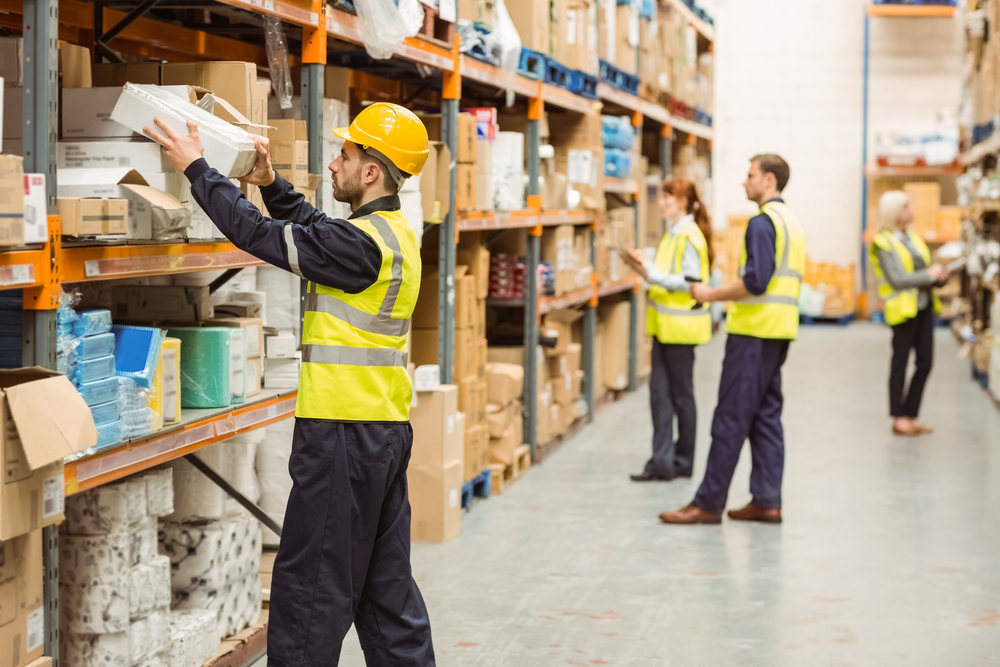
What you’ve probably not heard is that there’s another sector picking away at those potential driver candidates—and it’s in the warehouse. FreightWaves has documented the hot growth of the industrial real estate market over the past several months. We’ve covered ways to keep it lean and mean in the warehouse, as well as the need to modernize warehouses, and even this week, examined cutting-edge autonomous warehouse approaches.
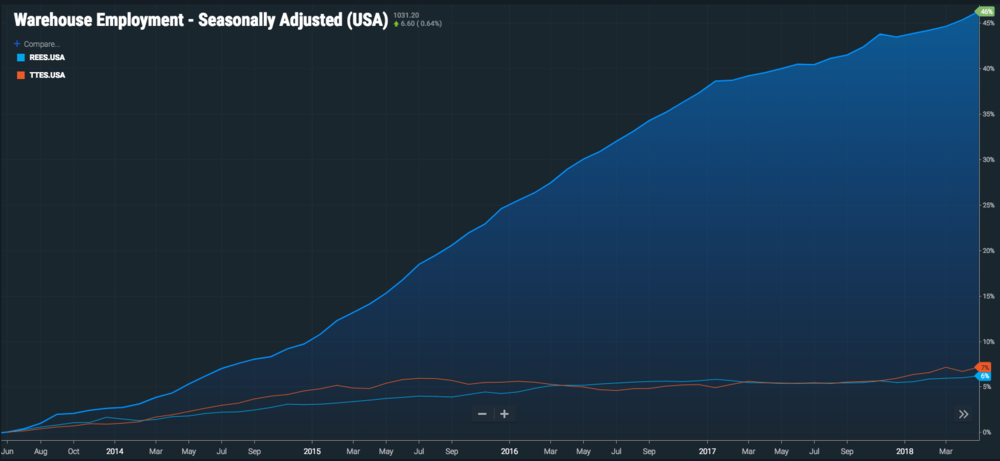
However, we have only recently uncovered the compelling trends through our SONAR Employment Data. Over a five-year period, the graph shows a clear disparity between warehouse employment growth as compared to the overall retail employment sector, and the trucking employment sector. Warehouse employment is up 52% while retail is up 7%, and trucker employment only up 6%.
 Over a five-year period, warehouse employment is up 52% while retail is up 7%, and trucker employment only up 6%.
OVER A FIVE-YEAR PERIOD, WAREHOUSE EMPLOYMENT IS UP 52% WHILE RETAIL IS UP 7%, AND TRUCKER EMPLOYMENT ONLY UP 6%.
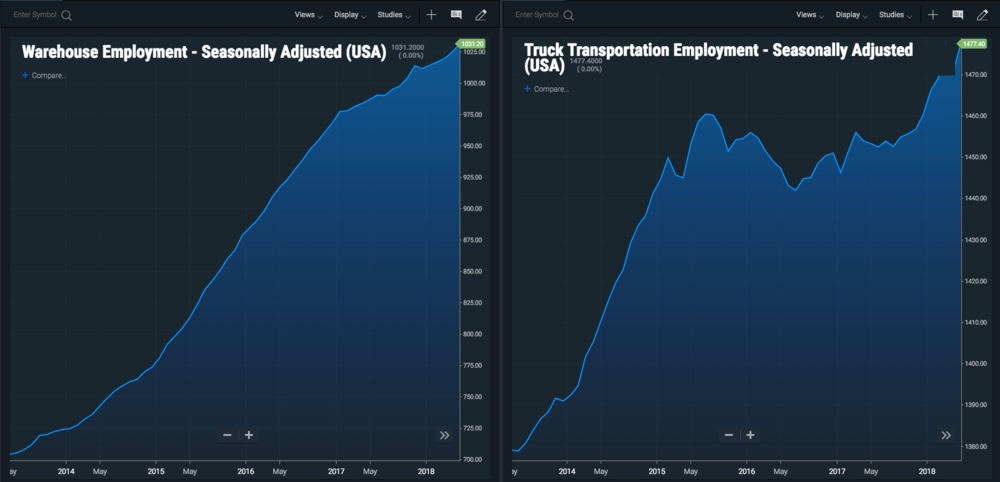
If the trend holds, in the next 7 years warehouse employment will be larger than truck transportation. Currently the sectors are at 1.02 million for warehouse and 1.475 million for trucking.
 It's not hard to see where this is heading if the trend continues.
IT’S NOT HARD TO SEE WHERE THIS IS HEADING IF THE TREND CONTINUES.
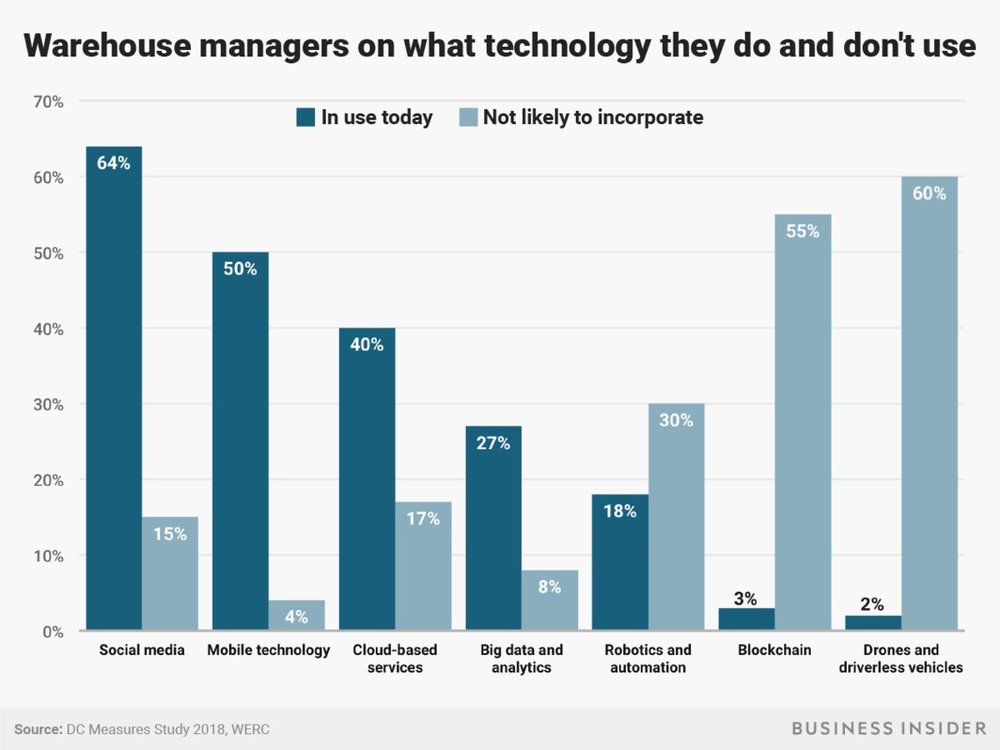
While the steady drumbeat for autonomous warehouses continues, especially from the likes of international majors, Alibaba and JD.com, it would seem that these are more things for headlines rather than the substance of boots-on-the-ground reality. Not only are the numbers telling us that employment is growing in the warehouse space, but so are the warehouse managers themselves. More than two-thirds of warehouse managers say people are the top priority in their operations, even as technology continues to make waves in headlines and at conferences, according to a recent survey by the Warehouse Education and Research Council (WERC).
The WERC report suggests people, not technology, are a facility’s greatest asset, and many have no plans to adopt emerging technology—even 10 years from now.
 According to the most recent WERC report, it's all about the personnel in the warehouse and very little about the headline-grabbing technology.
ACCORDING TO THE MOST RECENT WERC REPORT, IT’S ALL ABOUT THE PERSONNEL IN THE WAREHOUSE AND VERY LITTLE ABOUT THE HEADLINE-GRABBING TECHNOLOGY.
What else is happening? Shifting trends in manufacturing as they relate to e-commerce. Warehousing centers are getting closer to the end-user as well. Manufacturing is shrinking distance travel so it can keep inventory closer to the final destination. It’s all a function of the economy and the way that Amazon has pressed people into more regionalized networks. Amazon Prime is “kind of a big deal.”
Transportation costs in general are also increasing. Not only fuel, but also trade-related issues, and of course, having to pay drivers more and more. These could be mere “capacity crunch” issues, but so long as the economy thrives, they don’t seem to be going away.
Are we literally drawing a direct correlation to drivers leaving their jobs for warehouses? Of course not. On the other hand, the jobs are going somewhere, and they are certainly filling up the warehouses at a terrific clip. Could this be a part of the evolution of where the “new jobs” are going?
The majority of the trucking workforce is growing older. Over-the-road trucking could use a face lift with most Millennials. The median age of truckers is 10 years higher than that of other comparable industries, with a large number aged 55 or older. These drivers are reaching retirement over the next decade.
What will happen if capacity remains tight year after year? What will happen when the economy slackens? Truckers (and the industry) will adapt. They’re too essential, and this “ain’t their first rodeo.”
Meanwhile, however, many related jobs are heading–for now at least–into places like the increasingly efficient warehouses.

Thursday, June 28, 2018

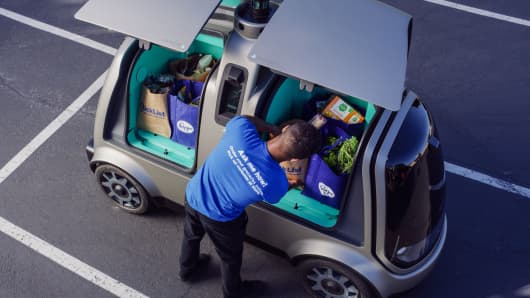
Kroger to bring driverless cars to grocery delivery

  • Kroger is partnering with autonomous car company Nuro to introduce driverless cars to its grocery delivery.
  • Kroger has made a number of investments toward expanding its digital and online delivery business.
  • “Last mile delivery” is one of the hardest feats in the delivery of fresh food.
Source: Kroger
Kroger announced plans Thursday to partner with driverless car company Nuro to deliver groceries using its autonomous vehicles.
The partnership comes as the largest U.S. grocery players continue to tackle the expensive challenge of “last mile delivery” — the final step in getting a product to a shopper’s home. It is a feat that is particularly perilous when dealing with fragile products like fresh food. It is further complicated by populations that vary wildly across the U.S., with some far less dense that others.
Walmart recently said it was partnering with Postmates to expand its online grocery delivery program. Amazon announced early Thursday plans to work with entrepreneurs who run their own local delivery networks of up to 40 delivery vans. It is not clear whether it will use that network for food delivery.
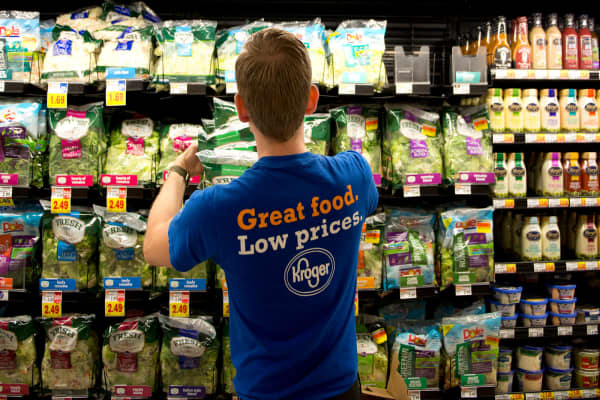
Kroger, meantime, has made a series of bold steps over the past few months to further its online grocery and delivery business. It announced its investment in British online grocer Ocado, which it will use to build out automated warehouses throughout the U.S. It also bought meal kit company Home Chef.
Kroger shares surge on earnings beat
Kroger shares surge on earnings beat  
Earlier this month, it said that digital sales for the past quarter had grown 66 percent.
“We cannot just rely on physical stores to reach all of our customers for delivery and and pick-up,” said Yael Cosset, Kroger’s chief digital officer, in an interview with CNBC.
Kroger has more than 2,800 stores across the U.S., under banners like Fred Meyer, Ralph’s and Harris Teeter.
Nuro, founded in 2016 by Google engineers, is an autonomous car company built explicitly for the business of transporting goods. That means its cars are slimmer and designed differently than ones meant to carry people. Nuro does not yet have special refrigerated cars, but is working on a new iteration of vehicles with such technology.
“You do not want to give Jeff Bezos a seven-year head start.”
Hear what else Buffett has to say
Kroger and Nuro will begin their partnership this fall. Cosset did not detail a timeline, but did say it would be “aggressive.” It will experiment with the technology in areas that both overlap with and are separate from where it plans to build out its Ocado warehouses.
“Where you have high density, an autonomous vehicle may not be the best solution,” he noted.
Eventually, though “you can expect the roll out of Ocado as well as fulfillment capabilities, autonomous delivery … to be available to 100 percent of America,” said Cosset.
In its earlier days, shoppers will need to schedule windows of delivery in advance, but Dave Ferguson, Nuro’s co-founder, said he envisions a longer-term model through which shoppers order more on-demand. Nuro also plans partnerships with other retailers beyond Kroger, which it may build by sharing a cut of the revenue.
Still, with driverless grocery delivery in its infancy, the Kroger partnership faces a number of uncertainties. It will take time to build out the infrastructure necessary to support it at scale. Planning for expansion is difficult because demographics across the U.S. may differ in 10 or 20 years. Meantime, markets across the country vary drastically in when, what and how frequently they order their groceries.
There is also the importance of making sure someone is home to pick up the groceries once they are delivered to the house.
And there are legal questions, should the driverless cars lead to accidents.
“It’s our responsibility to make sure those vehicles are safe and safely navigating the roads,” said Nuro’s Ferguson.

Driverless Grocery Delivery

Driverless grocery store ready to roll out pilot in two markets